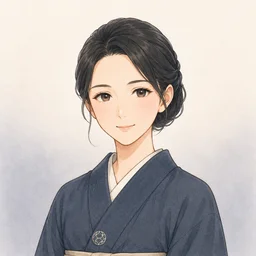
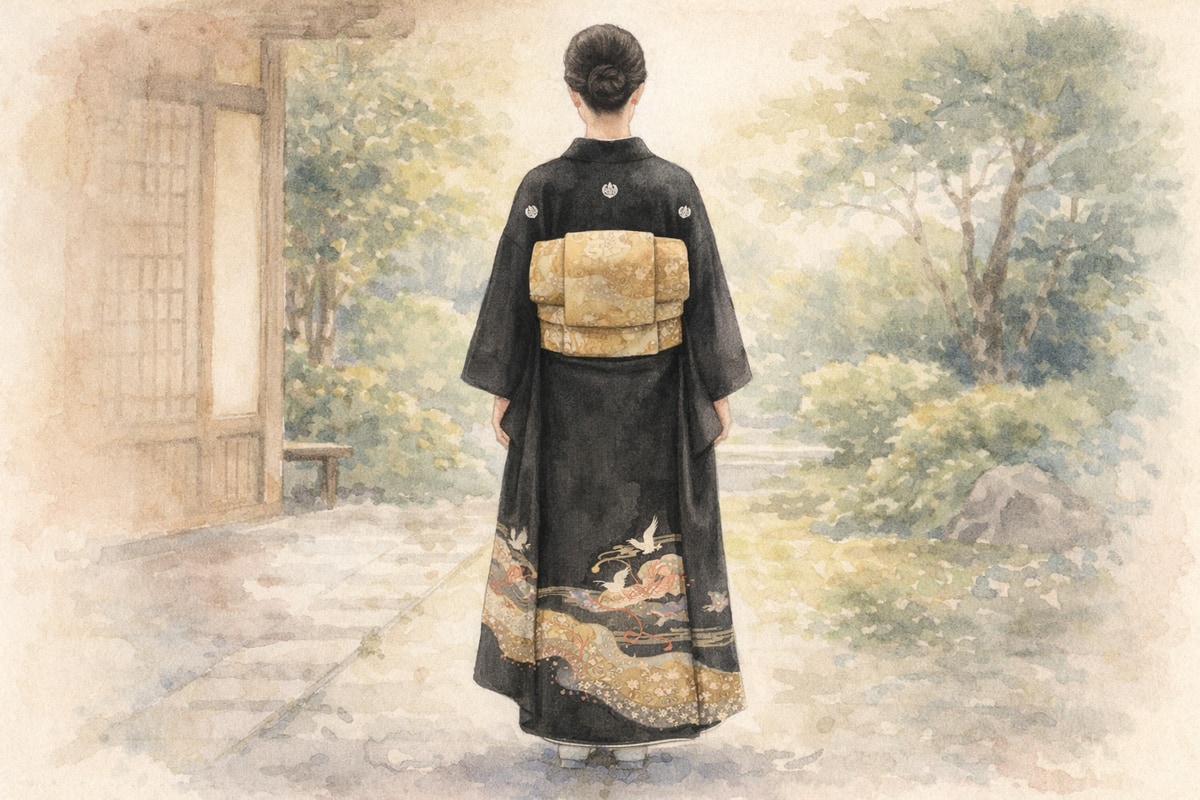
When it’s decided that you’ll wear a kurotomesode to your child’s wedding, have you ever paused to wonder why? Why black, and why as many as five crests? In fact, this attire has traveled a long road since the Edo period. Let’s trace it step by step.
Let’s start with the conclusion
To put the conclusion first: kurotomesode (a black kimono with five crests) is the formal dress of the highest rank for married women, and it is worn only by close relatives of the bride and groom and by the go-between’s wife. The current form—black fabric with five crests—is said to have become fixed after the Meiji era, and some say it only spread through society as a whole after the Second World War. Although it looks like an attire with a long history, the version we see today is actually a fairly recent one.
When did kurotomesode become the formal dress for married women?
The name tomesode is said to come from the practice of shortening the long sleeves of a furisode (a long-sleeved formal kimono) worn at weddings—essentially “stopping,” or tome-ing, the sleeve opening. By the latter half of the Edo period, the prototype of the kurotomesode had already spread widely: black chirimen (crepe silk) with five crests, patterned only along the hem. This hem design is called edozuma, and one theory holds that it imitated the dress of attendants in the Ōoku (the shogun’s inner palace) or of geisha, while another traces it to the modest, restrained placement of patterns favored by samurai families. It’s difficult to say which theory is correct, and several accounts are still passed down today.
The black background color is thought to reflect the influence of Western black formalwear. From the Meiji era onward, black tomesode and irotomesode (colored tomesode) came to be distinguished by name, and the idea that black was the truly formal choice gradually took hold. Some point out that because pale colors were considered inauspicious at Edo-period weddings, the deepest black may have come to be regarded as the most prestigious color.
Later, during the wartime years of the Showa era, lavish wedding attire disappeared, and there was a movement to refashion black hikifurisode (black trailing furisode) into tomesode. It is widely believed that the crested kurotomesode only became firmly established as formal wear for women after the war, in the postwar Showa period. We tend to imagine tradition as something ancient and unbroken, but in the case of the kurotomesode, the story is surprisingly recent.
The meaning of the five crests and their connection to family crests
A kurotomesode bears five family crests in total, dyed in the reserved white “hinata” style: one on the back, two on the chest, and two on the back of the sleeves. This set of five crests is required on both the kurotomesode and the black mourning kimono. Each position is said to carry its own meaning: the back crest represents one’s ancestors, the chest crests (dakimon) represent one’s parents, and the sleeve crests represent siblings and other relatives. In other words, the five crests together symbolize a person’s lineage and family.
At weddings, it is traditional etiquette for the mothers of the bride and groom to wear the most formal version—the five-crest kurotomesode. So as not to outrank the mothers, it has become increasingly common for other female relatives to wear a slightly less formal option, such as a three-crest irotomesode. There is no fixed rule about which family crest should be used; it varies by region and by family custom. In many areas, it is common to use the crest of one’s birth family before marriage and the crest of one’s married family afterward, while in parts of the Kansai region, a custom called “onnamon” survives, in which a crest is passed down through women only—from mother to daughter to granddaughter. For more on how crests are applied, see Kimono Crests: What Changes Between Five, Three, and One?, which offers a deeper look at the subject.
The origin of the black fabric and how it differs from irotomesode
Irotomesode is often confused with kurotomesode. Irotomesode was originally, like kurotomesode, formal dress reserved for married women, but today it can be worn by both married and unmarried women, and when it bears five crests, it is treated as equal in formality to the kurotomesode. Part of the reason irotomesode came to be worn by unmarried women as well is that older unmarried women often found it difficult to wear a furisode.
That said, there are occasions where irotomesode is actually the more appropriate choice. Within the Imperial Court, black is considered a color of mourning, so irotomesode—rather than kurotomesode—is worn by members of the Imperial family and at court appearances for the conferral of honors. It isn’t simply a matter of black always being the most formal; it’s reassuring to remember that color carries meaning appropriate to the occasion. If you’d like to compare kurotomesode, irotomesode, and houmongi (a semi-formal kimono) side by side, The Difference Between Kurotomesode, Irotomesode, and Houmongi is a helpful reference.
Regional and historical variations in tomesode customs
Kurotomesode customs are not identical everywhere in Japan. In some regions, it remains customary for all female relatives—not just the mothers of the bride and groom—to wear kurotomesode. Since it’s considered desirable for both families to match in formality at a wedding, it’s wise to check in advance with both families about who will wear kurotomesode and how the crests should be applied, so there’s no last-minute confusion on the day itself. The handling of family crests themselves can also differ between the Kanto and Kansai regions. Since this can vary depending on your position and region, it’s worth a quick confirmation beforehand.
Why kurotomesode remains the choice at weddings today
Even now, when Western-style weddings have become the norm, kurotomesode continues to be chosen as the mother’s attire—perhaps because the five-crest format itself carries meaning about the bond between two families. Some note that even though the upper body shows nothing but crests, the effect conveys the dignity of a family lineage—a weight quite different from mere showiness.
Since occasions for wearing it are limited, many people find themselves wondering whether to buy or rent. For a general guide to timing and typical costs, see Kurotomesode and Irotomesode: Is Renting or Buying Better?, which may be worth considering alongside this article.
In closing
Both the black fabric and the five crests of the kurotomesode, once traced back, turn out to have settled into their current form only gradually—from Edo-period wedding attire, through Meiji-era Western influence, to postwar standardization. Knowing that even the placement of each crest carries thoughts of ancestors, parents, and siblings may change how it feels the moment you put it on. Having said all this about its origins, what matters most, in the end, is simply standing warmly beside your child on their special day. On the day itself, we hope you can slip into your sleeves with a calm and peaceful heart.