Imagine unfolding your mother’s black tomesode before a wedding invitation. On the back, and on both sleeves and both sides of the chest — five places altogether — the same crest sits quietly. The houmongi (a semi-formal kimono) next to it has no crest at all. Have you ever paused, wondering what this difference means?
The crests on a kimono are symbols that speak of formality through their number alone. Five crests represent the highest formality, followed by three crests, then one crest, in descending order of rank — this is the single biggest rule in the world of kamon (kimono crests). Let’s unfold a small story behind today’s garment.
The Number of Crests Determines the Rank — Five, Three, or One
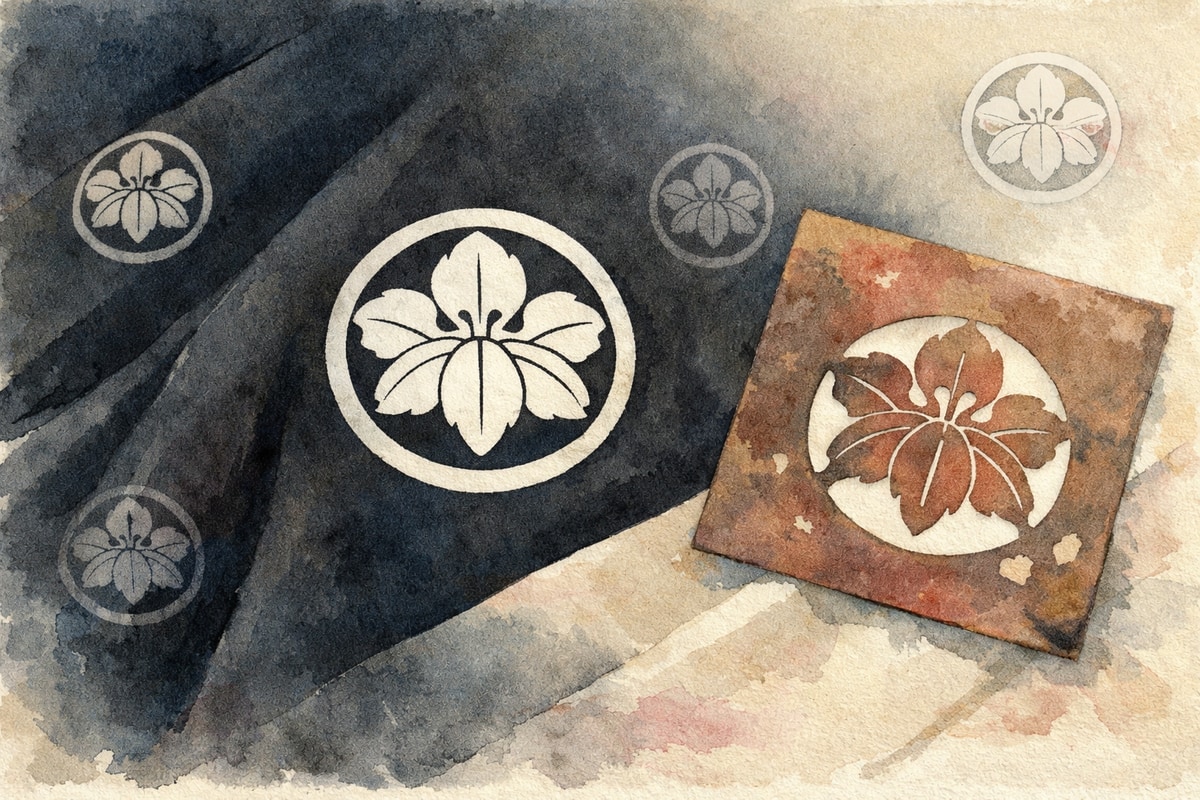
Crests have fixed positions where they can appear. A single crest, or hitotsu-mon, appears only as the “se-mon” on the back seam. Three crests, or mitsu-mon, add “sode-mon” on both back sleeves in addition to the se-mon. Five crests, or itsutsu-mon, add “daki-mon” on both sides of the chest, on top of the se-mon and sode-mon. The more crests there are, the higher the formality — a rule that holds true for both black tomesode and iro tomesode. Understood this way, it becomes clear that placing crests at five points to encircle the body was the mark of the most formal attire of all.
The Kimono Type Determines How Many Crests Can Be Used
That said, not every kimono can carry all five levels of crests. A black tomesode takes only five crests. An iro tomesode can range from one to five crests. A houmongi or iromuji can take one to three crests, while an Edo komon is limited to a single crest. Three crests rank just below five, and cannot be used for the most formal occasions — instead, they place the garment at the same semi-formal level as a houmongi. Reading up on the differences between black tomesode, iro tomesode, and houmongi first will make the meaning behind the number of crests much easier to grasp.
For iromuji as well, whether or not a crest is present changes the occasions it suits. For guidance on choosing between crested and crest-free iromuji for occasions like school entrance ceremonies or tea gatherings, see Iromuji and Crests: How Formality Changes, and How to Choose for School Entrance Ceremonies and Tea Gatherings.
Onna-mon and Family Crests — Different Ways of Passing Them Down
When people think of kamon, they usually picture the father’s family crest, but there is also the concept of onna-mon, or “women’s crest.” Rather than the father’s crest, an onna-mon is passed down from mother to daughter, through the female line. It is said to have emerged around the mid-Edo period, spreading mainly through western Japan — from Owari westward, centered on the Seto Inland Sea coast — and is said to be rarely seen in eastern Japan. One theory suggests this custom took root in merchant households in the Kansai region, where a matrilineal tradition of passing the household on through daughters had become established.
How onna-mon is handled varies by region and family custom, and in recent years, a shift has emerged in which the crest of the family one marries into is placed on a newly made kimono instead. One example often cited as symbolic of onna-mon is a case where sisters each had the same “agari-fuji” crest dyed onto five spots of their own differently colored iromuji. Seeing an onna-mon in this way can bring a quietly tender feeling, almost like glimpsing how a family itself continues on.
Dyed Crests and Embroidered Crests — A Difference in Rank by Technique
Crests vary in formality not only by number but also by the technique used to render them. The highest-ranking method is the dyed crest, or some-nuki mon, in which the area of the crest is left undyed white while the rest of the white fabric is dyed around it. It is painstaking work, and even within this category, formality descends in the order “dyed hinata-mon,” “dyed chuin-mon,” and “dyed kage-mon.” For formal wear, the dyed hinata-mon is the standard choice.
Embroidered crests, or nui-mon, on the other hand, are considered more casual than dyed crests. Placing one on an iromuji or houmongi does bring the garment to semi-formal status, but it is not meant to carry the same rank as a dyed crest. Nui-mon are often used for single crests, and can be a good option when you want to keep the formality slightly more restrained. Dyed or embroidered — even the same crest can speak with a different voice of formality depending on the technique chosen, which is a rather elegant kind of system.
How Crests Are Treated in Formal Wear Today
The more one learns, the more detailed the rules around kamon turn out to be — yet contemporary dress shows a somewhat different face. Houmongi once sometimes carried three crests, but these are rarely seen today, and when a crest is added at all, a single crest is now the norm. The spread of kimono rental is said to be one reason behind the increase in crest-free houmongi.
Adding a crest raises the formality of a garment, and a single crest or more is generally considered desirable for formal occasions — yet wearing a crest-free houmongi to a wedding or reception is no longer unusual today. For a breakdown of how to choose kimono for weddings depending on your role as a guest, see Wearing Kimono as a Wedding Guest: Choices by Role (Family, Friend, Colleague), and consider it alongside the question of crests or no crests.
The number of crests, how they are passed down, whether dyed or embroidered — even a single kamon carries several overlapping measures of meaning. The next time you spot a crest on someone’s tomesode or houmongi, you might find yourself quietly counting how many are there. As the breeze that calls for hitoe kimono grows near, such small observations are one more small pleasure in the enjoyment of kimono.