
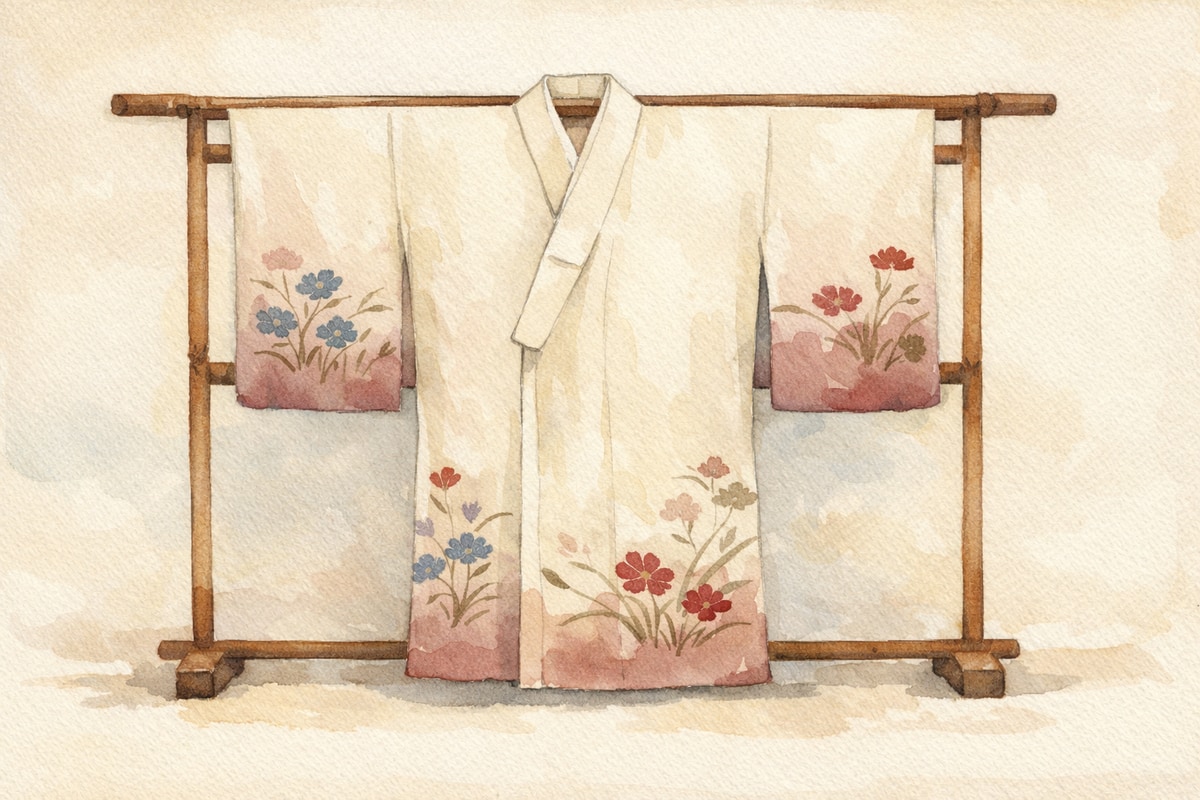
“I wonder if this size will actually fit me…” When choosing a kimono through mail order or a rental site, do you just enter your height and call it done? Actually, that’s a bit risky. Kimono sizing involves more points of reference than Western clothing, so height alone doesn’t tell the whole story. That said, it’s not complicated — you really only need to know three things: mitake, yuki, and body width. Once you’ve got a handle on these, you’ll make far fewer mistakes whether you’re renting or buying.
Kimono Size Isn’t Actually Determined by Height Alone
With Western clothes, a size “M” usually gets the point across, but kimono sizing is a combination of several measurements: the length from the shoulder seam to the hem (mitake), the length to the cuff (yuki), and the width across the body (body width). Between us, this is exactly where most people get confused. The meaning of a number changes depending on what’s being measured, so knowing “what” is being measured first will make everything that follows click into place much more easily.
Three Measurements Worth Knowing First (Mitake, Yuki, and Body Width)
Mitake (the kimono’s overall length) is the length from the shoulder seam (the highest point of the shoulder) to the hem, or from the very top of the center back seam to the hem. If this is too long or too short relative to your height, it can dramatically change the overall impression the kimono gives.
Yuki (the sleeve length from center-back to wrist) is the length from the base of the neck at the back, across the shoulder, to where the wrist bone protrudes (the cuff). The standard is to measure with the arm lowered at a 45-degree angle. If this measurement is too short, the wrist peeks out past the sode, which turns out to be surprisingly noticeable.
And then there’s body width. For women, this is measured at the fullest point of the hips; for men, from the waist to the fullest point of the hips. If you’re not confident about kimono terminology or parts, checking the Illustrated Glossary of Kimono Names and Parts alongside this article can make it much easier to follow which part is being discussed.
How to Measure Yourself with Just a Tape Measure
Knowing your own measurements before visiting a shop or ordering online makes choosing a kimono much easier. All you need is a single tape measure. Let’s go through it step by step.
Guideline for Mitake
A common guideline is that mitake should be roughly your height plus or minus 5cm. If nothing matches exactly, it’s fine to widen that range to plus or minus 10cm. That said, mitake numbers can differ for the same kimono depending on whether the measurement was taken from the shoulder or from the back seam, so when buying or renting, it’s reassuring to confirm which standard was used for the listed number.
Guideline for Yuki
The ideal yuki for you is generally considered to be the length from the base of the neck at the back to the wrist bone (where the bone protrudes). Try measuring it in one continuous line — from the back of the neck, over the shoulder, to the wrist — with your arm lowered at a 45-degree angle. It also helps to adjust slightly for body type: if you’re slender, add about 1–2cm; if your bust measures 90cm or more, add about 2–3cm; and if you want extra room around the upper arms or back, adding about 4–5cm can help you feel less constrained while wearing it.
How to Measure Body Width
As mentioned above, body width is measured at the fullest point of the hips for women, and from the waist to the fullest point of the hips for men. If this measurement is too narrow, the front of the kimono can come open as you walk, so it’s worth checking carefully against your own body type.
Measuring a Kimono You Already Own
If you want to check whether a kimono you already own fits you, simply lay it flat on the floor and measure directly: from the shoulder seam to the hem (mitake), and from the center back seam to the cuff (yuki). This is actually a spot where numbers can vary quite a bit depending on measuring method — mitake measured from the shoulder versus from the back can differ by as much as 6–8cm. Since individual body differences also come into play, it’s best to treat the numbers on a size chart as general guidelines rather than exact figures. If, after measuring, something feels clearly too small or too large, you might also find it helpful to check How Far Can Kimono Yuki and Mitake Be Altered? Understanding Seam Allowances and Tips for Requesting Alterations.
Size Guidelines by Height and Body Type (For Reference Only)
Mitake guidelines are often given as rough ranges by height bracket, but it’s reassuring to keep in mind that these numbers, too, shift depending on the measuring standard used. For men’s kimono length, a common guideline is your height minus about 27cm for an average build, minus 30cm for a slender build, and minus 25cm for a fuller build — you can see just how much body type affects the ideal number. If you’re a man puzzling over yukata (a light cotton summer kimono) sizing, it’s worth also looking at the Guide to Choosing Men’s Yukata: A Gentle Explanation of Sizing, Patterns and Colors, and Obi Knots to get the fuller picture.
Even when mitake doesn’t perfectly match your height, kitsuke (dressing in kimono) techniques can often compensate. That said, if the difference is quite large, it’s worth considering options like having the kimono altered or choosing to rent instead.
What to Do If the Size Doesn’t Fit
This might be the single most important point in this whole article. If your self-measured numbers don’t perfectly match a size chart, there’s no need to panic. Kimono are constructed to be adjusted through the ohashori (the fold tucked at the waist) and how the yuki is displayed, so a discrepancy of a few centimeters rarely causes real problems. If the mitake runs a bit long, you can compensate by making a deeper ohashori fold; if it runs a bit short, you can adjust by positioning the koshihimo (waist cord) slightly lower.
With recycled kimono, each piece is measured by hand individually, and the fabric’s natural give can also introduce small discrepancies. A difference of under about 2cm can generally be treated as within the normal margin of error. Points worth checking when choosing a reused kimono are summarized in How to Choose a Reused Kimono: A Checklist for Size, Stains, and Odor, which is worth bookmarking for later.
In Closing
Once you know just three things about kimono sizing — mitake, yuki, and body width — much of the uncertainty around choosing one melts away. Even if the numbers don’t match exactly, there’s actually a surprisingly wide range that kitsuke techniques and alterations can cover. Start by measuring your own yuki and mitake with a single tape measure, and jot the numbers down. That alone will make your next kimono decision go much more smoothly.