
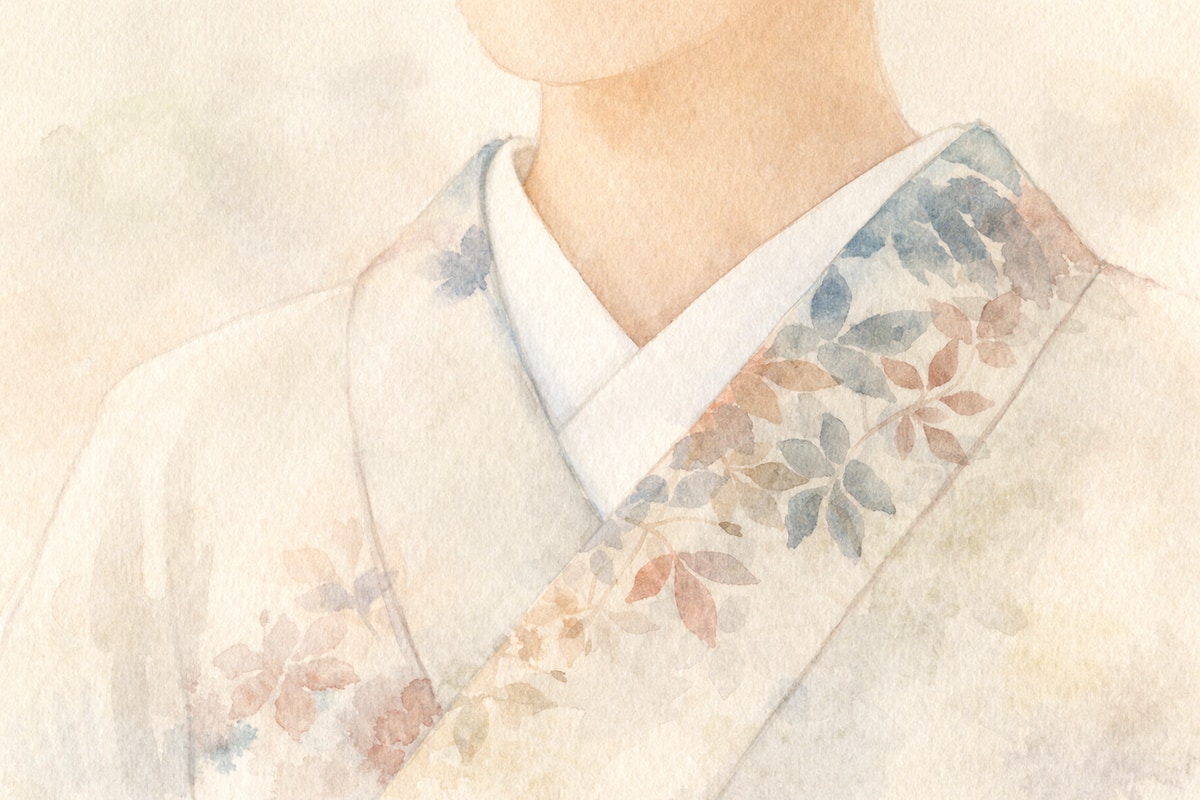
Do you ever realize you’ve been using the same haneri (the decorative collar attached to a nagajuban) all year round without noticing? When Iroha was just starting to learn kitsuke (dressing in kimono), it never occurred to her that even the haneri should change with the seasons — until a senior kindly pointed out, “That’s still your summer ro one, isn’t it?” The haneri is a small part of the outfit, but when its season is off, it tends to stand out more than you’d expect. Today let’s sort out when to change the haneri with the seasons, alongside the timing of the kimono’s seasonal wardrobe change.
The basic guide to changing haneri by season: three simple categories
To get straight to the point, you can think of the haneri’s seasonal changes on almost the same rhythm as the kimono’s seasonal wardrobe change. Broadly speaking, there are just three guidelines.
🌸 A rough guide to changing haneri by season
- October–May (awase/lined kimono, winter season): Thick, opaque shiose silk or chirimen crepe
- June and September (hitoe/unlined kimono season): Ro-chirimen and other haneri suited to hitoe kimono
- July and August (usumono/sheer kimono season): Sheer haneri such as ro (a sheer, gauzy summer silk) or asa-ro (sheer linen)
Just like with kimono, it’s customary in wasou (traditional Japanese dress) to change the haneri’s fabric with the season. From October through May — the awase and winter period — the basic choice is a thick, opaque shiose silk or chirimen crepe. Chirimen is dense and has more volume, making it suited to winter, and it’s generally recommended for wear from mid-November to mid-February. It’s a soft, warm fabric that’s perfect for the depths of winter.
Why the haneri changes in step with the hitoe and usumono wardrobe changes
You might wonder why the haneri needs to change at all. The reason is that the construction of the kimono itself changes with the season. The traditional guideline for the kimono’s seasonal wardrobe change is that October through May is for awase (lined kimono), June is for hitoe (unlined kimono), July and August are for usumono (sheer kimono), and September returns to hitoe. It helps to remember that the haneri’s fabric changes in step with the timing of the kimono’s own construction changes.
During the usumono season, sheer fabrics like ro and sha (a light open-weave sheer silk) are used, so if the haneri worn underneath is still a thick shiose, the overall look ends up mismatched with the season. The reverse is also true — continuing to use a summer ro haneri into the hitoe or awase season undercuts an otherwise well-chosen outfit. It’s considered undesirable to keep using summer accessories once summer has ended, and the general practice is to remove the ro haneri once September arrives and switch to one suited to the hitoe or awase season.
If you’d like to know more of the detailed rules behind the seasonal wardrobe change as a whole, take a look at When Does the Kimono Seasonal Wardrobe Change Happen? An Easy Guide to Telling Hitoe and Usumono Apart.
How to choose haneri fabric for each season
Now that you know the general guidelines, let’s go over which fabrics to actually choose. There are several types of haneri fabric, and it’s considered important to coordinate them to match the differences between seasons.
- Shiose: Also known as white shiose habutae, this is a classic fabric that works for both formal and casual occasions. Mainly suited to the awase and winter season
- Chirimen: Dense and full-bodied, suited to winter. Recommended for wear from mid-November to mid-February
- Ro: A sheer fabric, the “summer haneri” worn from June through late September. Pairs well with hitoe-style kimono
- Asa-ro and ro-chirimen: Like ro, these are fabrics commonly used during the hitoe season in June and September
- Yoryu: A crisp, summer-suited fabric with a crepe-like texture on its surface
Laid out this way, the logic becomes clear: “thick and opaque means winter,” “thin and sheer means summer,” and “in between falls the hitoe season.” When you’re unsure which haneri to choose, start by checking whether the current period falls under awase, hitoe, or usumono, and work backward from there to the fabric.
How often should you change it, and how many do you really need?
If you’re thinking, “Do I need to buy a new one every season?” — don’t worry, you don’t need to collect a whole stack of haneri. Having just two — a white shiose and a ro-shiose — is said to be enough to cover the full range of seasons. The shiose is for the colder awase and hitoe periods, and the ro-shiose is for the warmer hitoe and usumono periods.
Start by keeping these two on hand as your basics, and you won’t have to wonder “which one do I need again?” every time the season changes. Once you’re more comfortable, you can gradually add patterned or colored haneri, or a chirimen one, to broaden your styling options. If you’d like to learn more about choosing and attaching haneri in general, see How to Choose and Attach a Haneri: An Easy Guide by Season and Occasion.
In summary: start by remembering the three categories
The guideline for changing your nagajuban’s haneri comes down to three categories: shiose or chirimen for the awase and winter period (October–May), ro-chirimen and similar fabrics for the hitoe season (June and September), and ro or asa-ro for the usumono season (July and August). Just remembering this simple rule — that the haneri changes in step with the timing of the kimono’s own construction changes — is enough to keep your look from feeling out of season. Why not start small, by keeping just a white shiose and a ro-shiose on hand?