Your eye catches on the surface of a yukata (a light cotton summer kimono) — a round, charming ring-shaped pattern. It looks cool and refreshing, so you lean in for a closer look, only to find it’s actually a snow motif. Wearing snow in the height of summer is a curious thing indeed. Look closer, and you’ll find this snow-ring pattern, called yukiwa, has two faces: one for winter, one for summer.
What Shape Is a Yukiwa?
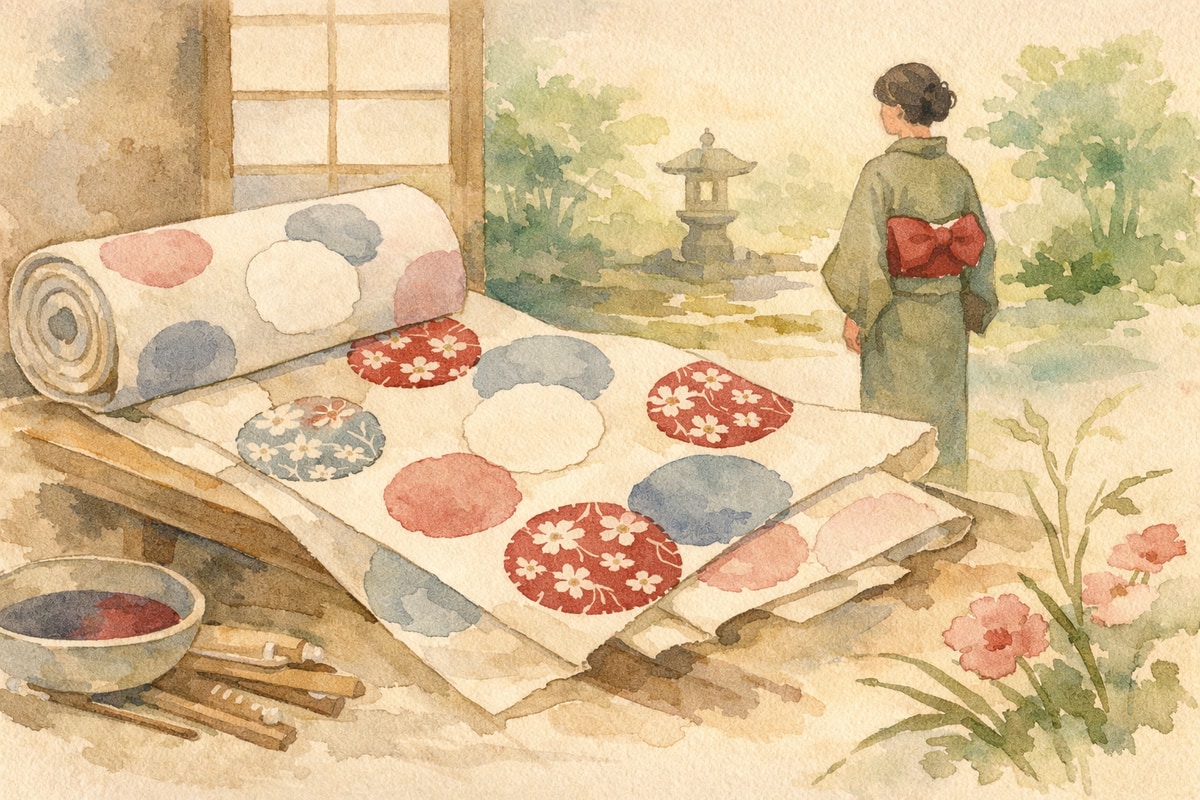
Yukiwa is one of the auspicious motifs (monyou) that stylizes a snow crystal. Rather than realistically depicting the snow crystal itself, it gathers the outline into a circle drawn with rounded curves. The basic form adds small notches or indentations along the edge of the round ring, gently hinting at the character of a snow crystal. Some versions are highly decorative, with flowers or other patterns drawn inside the circle, or with varying depths of the notches.
Tracing Its Origins
The attempt to represent snow as a motif is thought to have begun sometime between the Muromachi period and the Sengoku (Warring States) period. In the Momoyama period, a design called “yukimochi mon” — depicting snow piled on trees — came to be used on Noh costumes and kosode (an earlier form of kimono). A yukiwa-decorated kosode design is already recorded in the Goyo Hinagata-cho, a pattern book compiled in 1664 by the Kyoto kimono merchant Karigane-ya. At the time, the mainstream yukiwa was a circle with notches cut into it, and there was a truly wide range of variations — in the depth and number of the notches, and in whether the circle was rounded or not. It’s said that the yukiwa shape we commonly see today, a round outline with six notches, settled into place around the Genroku era. From the mid-17th century onward, this motif also came to be used frequently on Imari ware ceramics.
Incidentally, “sekka mon,” a motif that renders the snow crystal itself as a geometric regular hexagon, is a different pattern altogether. It spread after the publication of Hokuetsu Seppu and Sekka Zusetsu in the late Edo period, when observing snow crystals became a topic of popular interest. The round, soft yukiwa and the sekka mon that traces the crystal’s actual form may look similar, but it’s fascinating that they were born in different eras from different ideas.
Why a Winter Pattern Suits Summer
Snow motifs have long been treated as auspicious patterns wishing for a bountiful harvest, regardless of season. Beyond that, it’s said that Edo-period summer robes and yukata deliberately incorporated designs evoking winter, such as snow. The moment your eyes land on it, you feel a cool sensation — a kind of visual coolness — and that is the role of the yukiwa motif in summer. Alongside summer motifs like goldfish, morning glories, and seigaiha (blue ocean waves), yukiwa has also been chosen as one of the patterns that calls to mind coolness.
How to Think About When to Wear It: Yukiwa Year-Round, Yukimochi for Winter
Even among patterns motifed on snow, the thinking about when to wear them differs slightly. Yukimochi motifs — such as yukimochi willow, yukimochi bamboo grass, yukimochi pine, and yukimochi camellia — realistically depict plants covered in snow, so the seasonal feel comes through strongly, making them suited to wear as winter patterns. Yukiwa, on the other hand, is a circular pattern that abstracts snow itself. Rather than capturing a winter scene, it stands on its own as a cool, refreshing design, and so it has been cherished as a pattern that can be worn regardless of season. The idea that the timing for wearing a pattern depends on the pattern itself is a concept that also applies to motifs like cherry blossoms. If you’re ever unsure when to wear a seasonal pattern, asking whether it’s realistic or abstract can be one clue.
What Goes Inside the Yukiwa Ring
Part of the charm of yukiwa lies in what’s inside the ring. Some depict flowers or small patterns within the circle, while others vary the notches of the outline itself — so even though it’s the same yukiwa, the expressions are diverse. Packing both coolness and a wish for good fortune into a single circle — the more you learn about it, the more it feels like a wonderfully luxurious idea for a pattern.
In Closing: One Motif, Two Faces — Winter and Summer
Yukiwa is a pattern that evokes winter, yet also suits summer kimono and yukata — and the reason is that it abstracts snow itself into a soft, round shape. While the realistic yukimochi motif suits winter, yukiwa can be worn any time of year. Whether it’s the season when you start longing for the breeze of an unlined kimono, or the height of a blazing summer day, the round yukiwa quietly carries with it a lovable sense of coolness. May today’s outfit carry a small story of its own.