
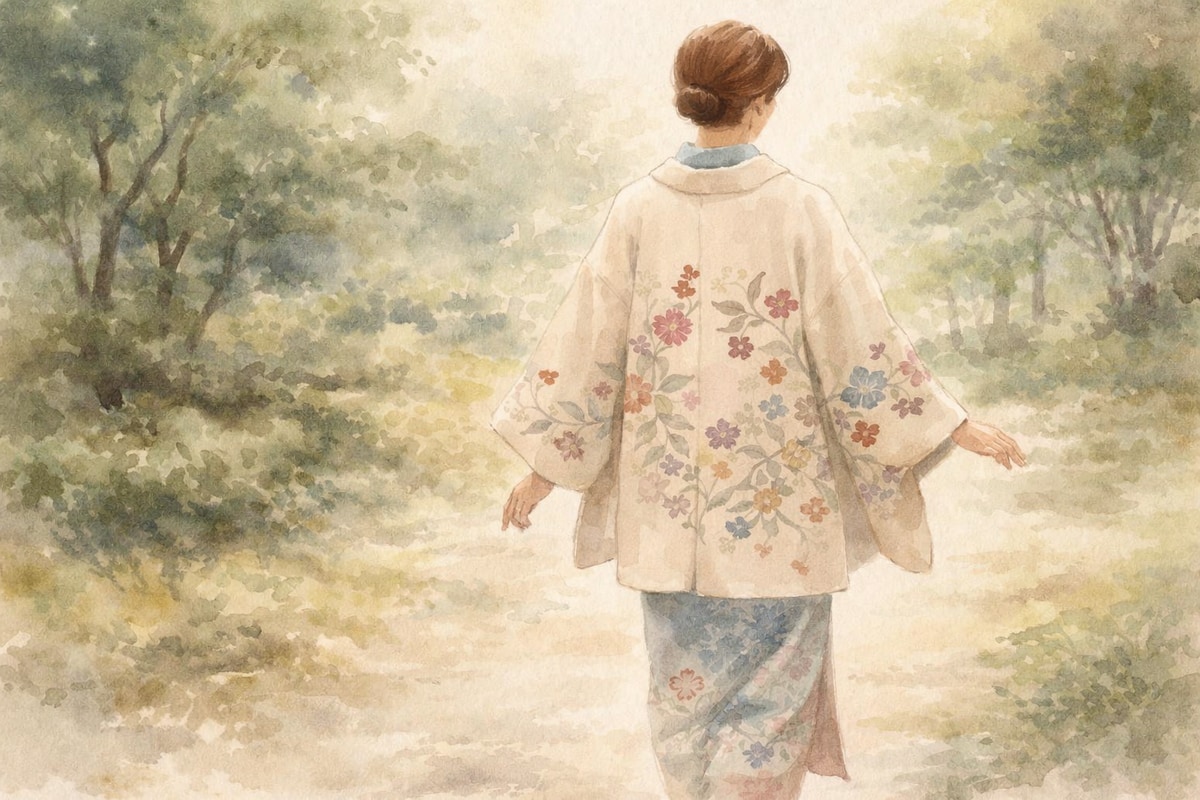
Have you ever paused at the entrance to a tea gathering or a meal, unsure whether to keep your outer layer on or take it off before stepping inside? Maybe you noticed the person next to you slipping theirs off and hurried to do the same. As it turns out, the answer depends on whether you’re wearing a haori or a coat.
Telling Haori and Michiyuki Coats Apart by Look
A haori is an outer layer worn open at the front, with a small loop at the chest (called a chi) for attaching a haori cord. The chi is generally positioned just below the top line of the obi (the wide sash tied around a kimono). There are two lengths: the knee-length “nagabaori” (long haori) and the shorter “chubaori” (mid-length haori), with more people today tending to choose the long version.
A michiyuki coat, on the other hand, has a completely different collar shape. Its defining feature is the michiyuki collar, cut into a square shape (also called a kaku-eri, or “square collar”), and it closes at the front with buttons. There are several subtypes of collar shaping — miyako-eri, hifu-eri, chiyoda-eri, hechima-eri, and more — but the square-collar impression is the easiest way to identify it at a glance. A related coat called the dochugi belongs to the same family; it’s worn with the collar folded over like a kimono and tied closed at the front with cords. Because it’s easy to put on and take off, it’s used as a more casual alternative to the michiyuki coat.
The Biggest Difference: Whether You Take It Off
More important than appearance is how each is treated indoors. A haori can be worn indoors without removing it, while a michiyuki coat and a dochugi are, by etiquette, taken off before entering a building. Both the michiyuki coat and the dochugi were originally outerwear meant to keep off dust or the cold, so it helps to think of them the same way you’d think of checking a Western-style coat at a cloakroom.
The moment to remove them is right at the entrance, before stepping inside. Folding the coat into a furoshiki (wrapping cloth) or bag to carry rather than setting it on the floor looks neater. As for how to take off a michiyuki coat or dochugi, the basic steps are almost the same as removing a haori — the only extra step for a dochugi is untying the front cords first — so once you’ve learned it, there’s no need to hesitate.
That said, there’s an exception even for haori. A long haori extending about 10cm below the knee is sometimes better removed at a tea gathering or in the presence of someone of higher status. It’s wise to keep an eye on those around you and follow suit as needed.
Formality and Occasion: Which One Works With Formal Kimono?
How each coat is used in formal settings also differs. The michiyuki coat has enough range to be worn with formal kimono — when pairing it with a tomesode or houmongi (a semi-formal kimono), the basic choice is a bokashi (gradated dye) fabric or an ebagara design (a pattern that forms one continuous picture across the fabric). The same michiyuki style made from tsumugi (a textured, hand-woven silk) becomes casual instead, so the fabric makes a big difference in the impression it gives. The dochugi, meanwhile, was originally a casual coat, and sits in a more relaxed position than the michiyuki coat.
As for the haori, it tends to be seen as something for everyday or casual outings, but a haori bearing a single crest (mon) can sometimes be treated as semi-formal wear. Conversely, when wearing formal black mourning kimono (kuromontsuki), a haori is considered too informal and should be avoided — the standard approach is to wear a black michiyuki coat and remove it before entering the venue. For solemn occasions like weddings and funerals, it helps to remember the general rule: no outer layer once you’re inside.
Choosing by Season: Haori and Coats
Haori also come in seasonal weights, including unlined (hitoe) and sheer summer (usumono) versions, and in hot weather a sheer, breathable fabric can help you feel cooler. For more on when to switch between hitoe and usumono, see When Does Kimono Seasonal Wardrobe Switching Happen? An Easy Guide to Hitoe and Usumono.
Coats really come into their own in winter. A thick michiyuki coat or dochugi made for warmth, worn over a kimono, makes a noticeable difference to how warm you feel. Incidentally, a rain coat worn on rainy days is a completely different item from a coat meant for warmth. For details on rain-ready fabrics and footwear precautions, see Kimono Rainy-Day Prep: Rain Coats, Tabi Covers, and Zori Covers, handy for days when the weather looks uncertain.
Which Should You Buy First?
With these differences in mind, it becomes easier to decide what to choose first. Because a haori doesn’t need to come off indoors, you’ll likely wear it for longer stretches, making it an easy, versatile item for everyday outings. Since it can be slipped on or off quickly just by undoing the haori cord, it’s also handy for a sudden chill.
On the other hand, if you have formal occasions coming up, or want a proper piece to pair with a houmongi or tomesode, a michiyuki coat will see more use. Because it works for both formal and casual looks, having one on hand really broadens your styling options. Choosing based on which occasions come up most often for you makes the decision much easier.
In Summary
You can tell a haori and a michiyuki coat apart by look — whether the front stays open or the collar is squared off — but the one thing worth remembering is whether you take it off indoors. A haori stays on; a michiyuki coat or dochugi comes off at the entrance. Once you’ve got that basic rule down, you can move through tea gatherings and meals without a moment’s hesitation. Just keep in the back of your mind that there are exceptions — a long haori, or occasions involving mourning wear — where following those around you is the safest choice.