
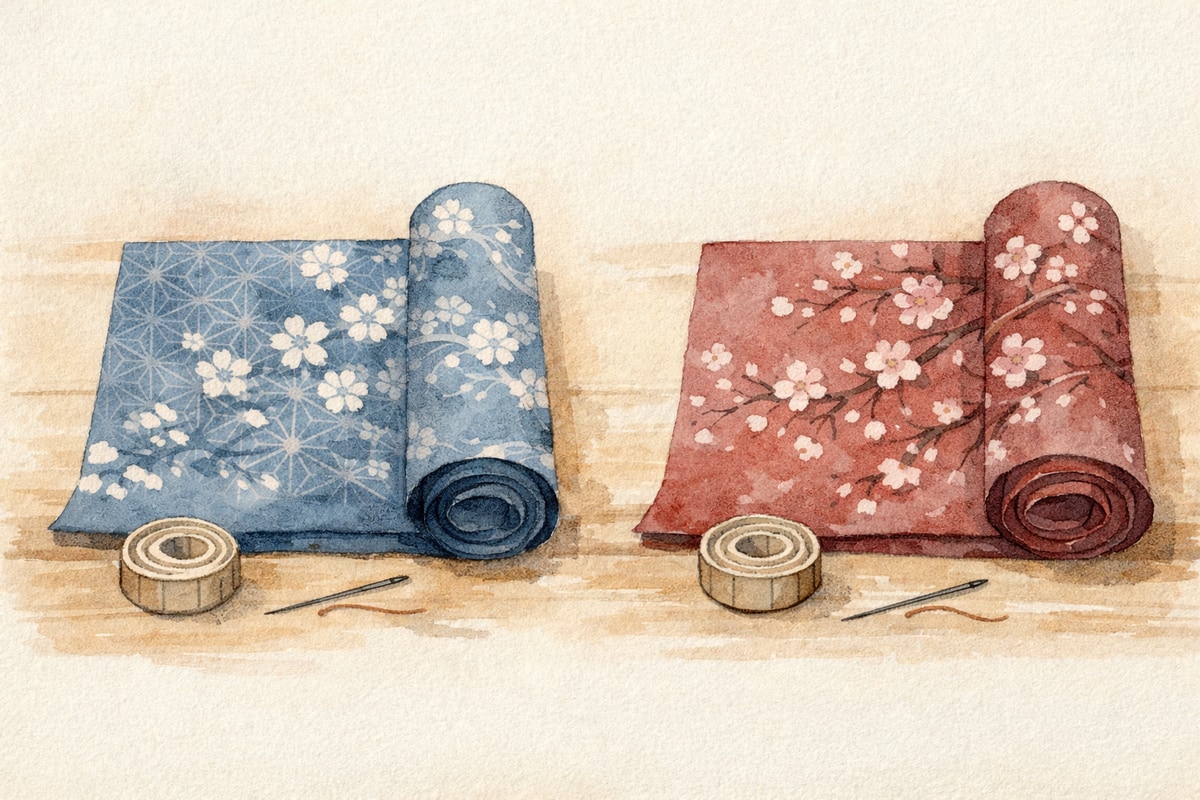
Have you ever unrolled a bolt of kimono cloth and wondered how on earth it turns into something that fits your body so precisely? Many of us have nodded along vaguely when a specialist kimono shop (gofukuten) asked, “How would you like this tailored?” Tailoring actually follows a clear, established sequence, from steaming the fabric all the way to the final stitches. Today, let’s walk through that process together, along with the basics of the measurements you’ll need to convey when placing an order.
What Does “Tailoring” Actually Mean?
Tailoring means taking a single bolt of cloth — tanmono (a bolt of kimono cloth) — and cutting and sewing it to fit an individual’s body, turning it into a finished kimono. A kimono is made by combining several parts: the sleeve (sode), the body panels, the okumi (a narrow strip of fabric added to the sides of the body panels), the collar (eri), and more. As a bolt of cloth, it’s just fabric — it only becomes something wearable once it has been tailored. Interestingly, a kimono can also be taken apart and returned to a single flat piece of cloth, a concept quite different from Western clothing. This is exactly why kimono can later be resized or re-tailored.
The Journey from Bolt of Cloth to Finished Kimono
The tailoring process broadly follows three stages: “preparing the fabric,” “cutting,” and “sewing.” Skipping a step affects the final result, so let’s look at what each stage involves.
Preparing the Fabric with Yunoshi and Mizutoshi
Before cutting, there’s a step to prepare the tanmono while it’s still rolled up. Yunoshi involves applying steam to soften the fabric while smoothing out wrinkles and evening out the warp and weft threads to align the width. This is done both as a finishing step after washing and re-stretching (araihari) and before tailoring. For tsumugi (a textured, hand-woven silk), a process called yudoshi is often used instead, which removes excess starch with hot water. For cotton and asa (linen/hemp) fabrics, a process called mizutoshi is used to even out the weave and pre-shrink the fabric, preventing further shrinkage after the kimono is finished. After mizutoshi, the fabric is ironed from the reverse side in one direction to align the grain, and if any flaws or dye unevenness are found at this stage, they’re marked with thread so the wasou (traditional Japanese dress) tailor can check them before sewing. Skipping this preparatory step can cause the finished kimono to shrink or warp — so while it might seem like a minor detail, it’s actually a crucial part of the process.
Cutting in Straight Lines: Seven Pieces in Total
Once prepared, the tanmono is cut into a set configuration: two sleeves, two body panels, two okumi, one collar, and one tomo-eri (an overlapping collar piece placed on top of the collar) — seven pieces in all. Since the width of a bolt of cloth is fixed at roughly 37cm, kimono cutting is fundamentally done in straight lines. The length of the tanmono is calculated based on height and hip measurements, typically around 12 meters. This method of piecing together straight-cut sections without cutting any curves is exactly why a kimono can be unstitched and returned to a single flat piece of cloth.
Hand-Sewing vs. Machine Sewing: What’s the Difference?
When it comes to sewing the cut pieces together, there are two methods: hand-sewing and machine sewing. In the world of wasou tailoring, hand-sewing remains the mainstream approach today — in fact, unless a shop specializes in machine tailoring, machine work can sometimes take even longer to complete. Hand-sewing allows a little slack in the thread, which helps distribute the strain placed on the fabric. The seam allowance (the width between the stitching line and the fabric edge) can be as narrow as 2–3mm with hand-sewing, whereas machine sewing requires roughly 1cm of allowance from the edge. Since sewing machines became widespread in the Meiji era, machine sewing spread as an efficient tailoring method, but today, many machine-sewn kimonos are produced at overseas sewing factories. Hand-sewing costs more and takes longer than machine sewing, but it puts less strain on the fabric and makes re-tailoring easier. If you’re trying to decide between having a kimono tailored from a bolt of cloth or choosing a ready-made one, you may find Tailored from a Bolt vs. Ready-Made Kimono: Which Should You Choose? helpful as well.
The Basics of Measurements: Three Numbers to Convey — Mitake, Yuki, and Body Width
When requesting tailoring, the biggest concern is usually how to convey your own measurements. Don’t worry — there are only three numbers to remember. Mitake (the kimono’s overall length) refers to the kimono’s length: for women, mitake equals height, while for men, since there’s no ohashori (the fold tucked in at the waist), mitake equals the actual finished length of the garment. Yuki (the sleeve length from center-back to wrist) is measured from the base of the back of the neck to the wrist bone, with the person standing straight and the arm extended at a 45-degree angle. Since the angle at which the arm is lowered can create a difference of about 3cm, it’s a good idea to measure both arms and take the average. Body width refers to the width of the body panels, determined by measuring the widest point around the hips to set the front and back panel widths. Kimono shops often still use the traditional kujira-jaku unit (1 shaku is about 38cm), but there’s no need to worry if you provide measurements in centimeters — the shop will convert them during tailoring. If this is your first time having a kimono tailored, simply providing your yuki, bust, waist, and hip measurements will allow the shop to calculate the mitake and body width for you. If you’d like to measure yourself and check your own figures, the article How Do You Measure Kimono Sizing? is worth a read too.
Where to Request Tailoring: The Process and What to Check
The usual approach is to bring your tanmono to a gofukuten or a specialist tailoring shop. The process generally proceeds in this order: “measuring,” “yunoshi and araihari,” “tailoring,” and “delivery,” with measurements calculated from height, bust, hip, and other figures. Good tailoring is said to result in a kimono that resists coming loose (kizukure), looks beautiful when worn, and can be folded without wrinkles once taken off — and this is only possible because a skilled wasou tailor carefully builds up each step of the process with care. Since whether a shop offers hand-sewing or machine sewing, and how long they’ll take to finish the work, varies from shop to shop, it’s reassuring to check these details before placing your order.
Re-Tailoring: Another Option
If a kimono you already own no longer fits, or if the fabric has become soiled, re-tailoring is an option instead of starting fresh from a bolt of cloth. The process involves unstitching the garment, washing and re-stretching it (araihari), then applying yunoshi again to prepare the fabric before re-sewing it. Since yunoshi is also used as a finishing step after araihari, the same small but essential step of preparing the fabric supports both original tailoring and re-tailoring. If you’re planning to wear a particular kimono for many years, keeping the option of re-tailoring in mind can make the decision of what to choose much easier.
In Summary
Tailoring means taking a single bolt of cloth and cutting and sewing it to fit an individual’s body, turning it into a kimono. The fabric is prepared through yunoshi and mizutoshi, cut in straight lines into seven pieces, and then sewn together using either hand-sewing or machine sewing. Once you understand this process, you’ll be able to answer confidently whatever a shop asks you. And when it comes to measurements, there are only three to convey — mitake, yuki, and body width — the shop will handle the rest, so there’s no need to overthink it. Once the tailoring process becomes clear, it should also be easier to decide whether to have a kimono tailored from a bolt of cloth or to choose a ready-made one. If you’re curious, do also read Tailored from a Bolt vs. Ready-Made Kimono: Which Should You Choose?.