
Have you ever frozen for a second when a kimono shop asked, “Would you like this tailored, or is ready-to-wear fine?” This is actually a choice unique to kimono — something Western clothing rarely asks of you. The short answer: choosing based on your body type and how often you’ll wear it makes the decision much easier. By the end of this article, you should be able to tell which option suits you.
What is a kimono tailored from a bolt of cloth, versus a ready-to-wear kimono?
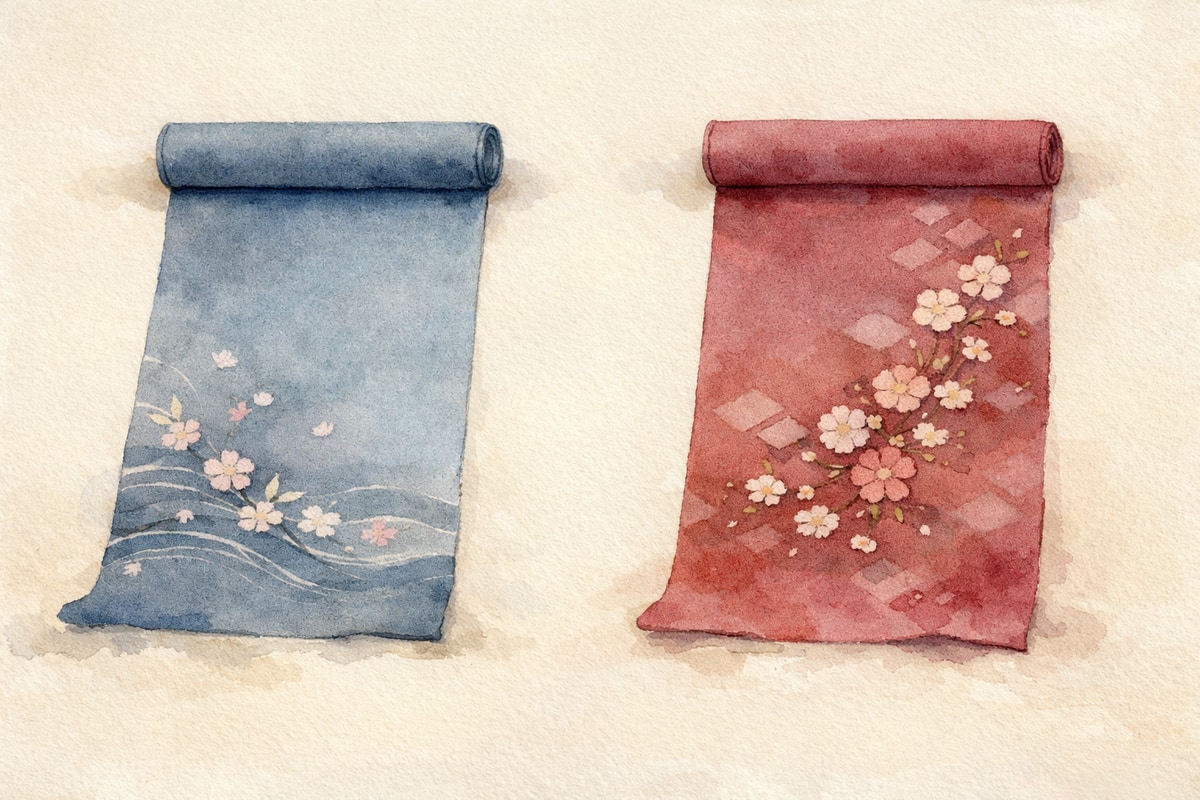
“Tailoring” a kimono means sewing it up from tanmono (a bolt of kimono cloth) — cloth that hasn’t yet been cut and sewn. Japan originally had no system of selling ready-made clothing the way Western fashion does today. You’d buy the tanmono and either ask a tailor to make it up or sew it yourself. In other words, the kimono was originally a made-to-order garment: you bought the fabric first, then had it made.
“Ready-to-wear,” on the other hand, refers to a kimono that’s already been sewn in a standard size. It’s a welcome option when you want to wear one right away. Between you and me, neither option is inherently better — it’s really about which suits your purpose.
Differences in sizing and how well it fits your body
Because ready-to-wear kimono are sewn to fit a general range of people, it’s rare for one to fit your body perfectly. Still, if you’re close to a standard build, small differences in length or width usually aren’t a problem, and since it arrives quickly after ordering, it’s a lifesaver when you need one on short notice.
A custom-tailored kimono, made to your measurements, drapes closer to the body, which helps prevent the kimono coming loose (kizukure) — one of its real appeals. Keep in mind that if you’re on the slim or fuller side, ready-to-wear sizes may simply not fit. Custom tailoring generally takes around 60 days as a rough guide, though this varies by season and shop.
When checking size, focus on three points: yuki (the sleeve length from center-back to wrist) — is it long enough to reach your wrist properly; miyuki (body width) — does the seam at the right side align with the edge of the overlapping front panel, and does the center-back seam sit at the center of your back; and mitake (the kimono’s overall length) — does it match your height. Even if it’s not a perfect fit, many size gaps within a reasonable range can be compensated for during kitsuke (dressing in kimono).
How to think about price, and roughly how long tailoring takes
Price needs to be considered in two separate parts: the cost of the tanmono and the cost of the tailoring itself. Ready-made kimono come from existing stock and arrive quickly, but the range of patterns and colors may be limited. A custom order becomes a piece that’s uniquely yours, but tailoring takes roughly 60 days, and if sizing adjustments are included, it can sometimes take four months or more, so if you already have a date in mind for wearing it, it’s reassuring to consult a shop early.
This is actually a point that’s easy to overlook when choosing a kimono. If you pick ready-to-wear purely because it’s cheaper, you might later find the yuki is too short for comfort. Rather than focusing on price alone, it helps to weigh it together with the timeline and the date you plan to wear it.
Why ready-to-wear can still be reassuring: the culture of size alterations
Even a kimono that doesn’t fit can often be altered by a skilled professional. Unlike Western clothing, kimono are typically constructed with extra fabric folded into the seams, and there’s a long-standing culture of unpicking and re-tailoring a kimono to fit. Buying ready-to-wear and having it altered later is a perfectly reasonable choice.
In re-tailoring, a specialist tailor finishes the garment according to careful measurements, and having a single craftsperson see it through to completion keeps the stitching consistent in strength and fineness. Once tailoring is complete, it’s common for multiple people to inspect the piece, checking closely for measurement errors, stains, or leftover needle marks. Knowing that even a kimono you set aside because “it didn’t fit” may still be alterable opens up far more options.
Kimono passed down from a parent or grandmother, or found secondhand, often come in inconsistent sizes — but the same approach to alteration can often apply here too. For checking the size of a handed-down kimono, you may also find it helpful to look at How to Choose a Secondhand Kimono: Checking Size, Stains, and Odor.
Who ready-to-wear suits best
Ready-to-wear is a good fit for those with a close-to-standard build, or anyone who needs a kimono right away. Many people also make small adjustments themselves — customizing the shoulder-to-sleeve length, or using kitsuke techniques to take up extra length or width. Once you get used to dressing yourself, these little adjustments can even become part of the fun.
Who custom tailoring from a bolt of cloth suits best
Custom tailoring is well suited to those who are slim or fuller-figured, or to anyone who wants to carefully choose a single piece — like a tsumugi (a textured, hand-woven silk) — meant to be worn for years. A piece made to fit your body drapes well and resists kizukure, giving you extra peace of mind on important occasions. Just remember to factor the roughly 60-day timeline into your plans ahead of time.
Points to check before you buy
Don’t worry — there are only two things to check. First, the three measurements: yuki, body width, and mitake. Second, whether there’s enough time between now and the date you want to wear it to allow for tailoring. Keep these two points in mind, and it becomes much easier to decide between ready-to-wear and custom tailoring.
If you’re still unsure, it can help to ask a specialist shop whether alterations are possible. For more detailed guidance on judging re-tailoring, information from wasai (traditional Japanese sewing) specialists can also be useful.
In summary
The kimono was originally a made-to-order garment — you bought the cloth, then had it tailored. That’s precisely why both ready-to-wear and custom tailoring have their own strengths. If you’re close to a standard build and want to wear it soon, ready-to-wear makes sense; if you care about a precise fit or want a piece to wear for years, tailoring from a bolt of cloth is the way to go. And even if a kimono no longer fits, there’s a long-standing culture of having it altered. Start by checking yuki, body width, and mitake, and choose by working backward from the date you want to wear it — keep just this in mind, and choosing a kimono should feel far less daunting. It’s worth keeping this guide handy for later.