
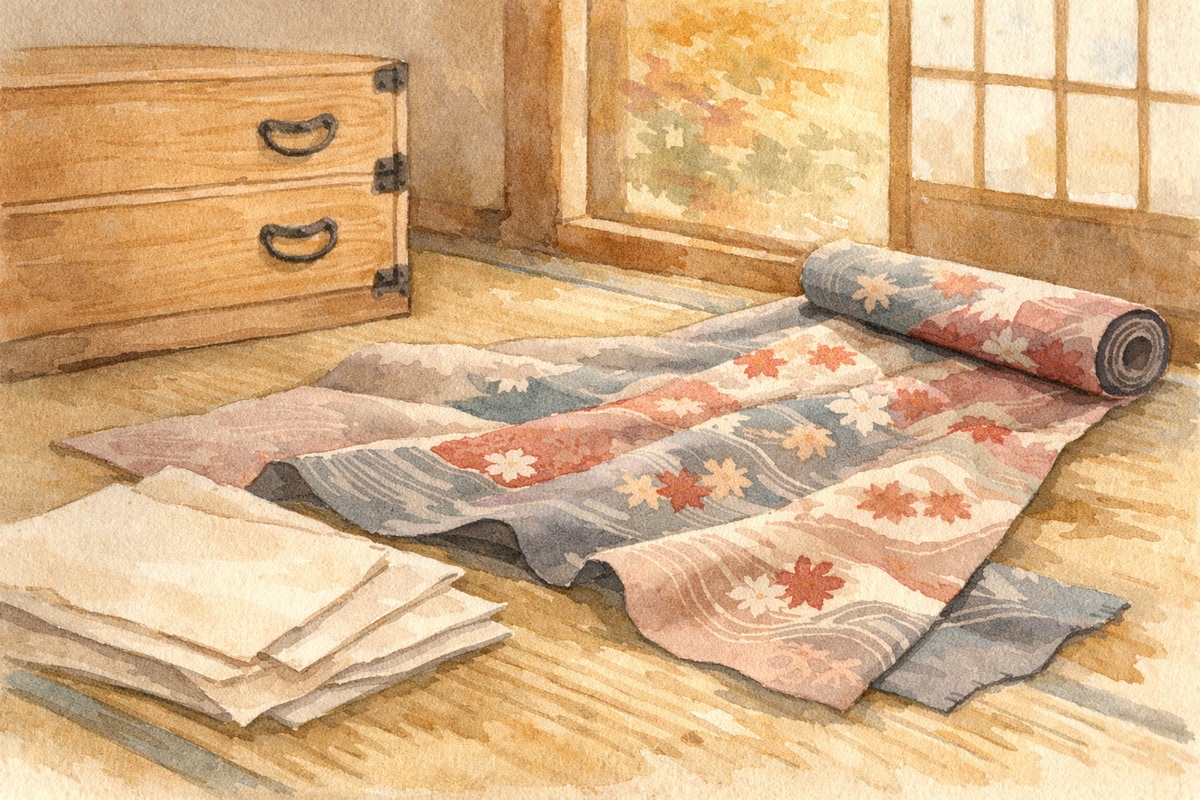
You open the paulownia wood chest you haven’t touched in a while, and a faint, damp smell drifts out — has that ever happened to you? Even when a kimono isn’t being worn, it’s quietly absorbing moisture inside the chest the whole time. Left unchecked, that moisture can lead to stains, mold, or insect damage. Airing out kimono (mushiboshi) is the seasonal care ritual that drives out that moisture. Let’s walk through when to do it and how much of it you can manage at home.
What does airing out actually do for a kimono?
Airing out means taking a kimono out of storage and letting it catch a breeze to release trapped moisture. Despite the name suggesting it’s mainly about keeping insects away, the bigger purpose is actually preventing moisture-related stains and mold. If a kimono stays packed away all year round, the humidity inside the chest gradually seeps into the fabric. The best way to help a kimono last is to give it some fresh air now and then, especially during the months you’re not wearing it.
When to air out kimono — doyo-boshi, autumn airing, and midwinter airing
Traditionally, airing out is done three times a year, at each seasonal turning point, and each session even has its own name. There’s doyo-boshi, which clears out the humidity left after the rainy season ends; the autumn airing, which deals with lingering moisture from summer into fall; and midwinter airing, done during the driest stretch of the year. As a rough guide, doyo-boshi falls in late July to early August, the autumn airing in late September to mid-October, and midwinter airing in late January to early February. Some people simply remember it as August, November, and February, and the exact wording varies a bit by source, but the underlying idea is the same: give the kimono a rest at three key turning points — right after the rainy season, when autumn humidity lingers, and during the dry depths of winter.
That said, these are only traditional guidelines. The climate has been shifting in recent years, so it’s no longer safe to say a given month is guaranteed to work. Even specialist kimono shops increasingly recommend simply picking a clear day in the middle of a dry spell — around Golden Week, or on a crisp autumn day, for instance — rather than fixing a date. It makes more sense to look for a stretch of clear weather with humidity around 40–60% and temperatures under about 20°C than to lock in a specific month. For summer airing, also avoid the days right before and after rain or typhoons. Even if the day itself is sunny, if it rained the day before, moisture will still be rising from the ground — better to wait one more day to be safe.
Steps for airing out kimono at home
Once you’ve settled on the timing, the rest is just following the steps. Don’t worry, there isn’t much to remember.
- Hang the kimono on a hanger
- Brush the surface gently with a soft brush to remove dust
- Check for stains or soiling under good light
- Let it air out in the shade, away from direct sunlight, for a few hours
The best window for airing is roughly 10 a.m. to 3 p.m. Mornings and evenings tend to be more humid, so sticking to this window helps keep moisture from creeping back in. For a kimono you already care for regularly, three to five hours in the shade is plenty. But for one you’ve just worn — which holds more sweat and moisture — give it a longer rest of one to two days in the shade. A fan set on low can speed up the drying, which is handy when you’re short on time.
No good weather, no outdoor space? Here’s what to do
Plenty of people live in apartments without a garden, or simply can’t count on a run of clear days. In those cases, airing out indoors works perfectly well. The basic approach is to choose a well-ventilated room, open the windows, and let air circulate while the kimono airs out. On days when outdoor humidity is high, use an air conditioner or dehumidifier to bring down the humidity in the room. Direct sunlight causes fading, so make sure to pick a spot away from it even indoors.
It’s also a good idea to air out the tatoushi (a paper wrapper for storing kimono) — the washi paper envelope that wraps each kimono individually — at the same time. Since the tatoushi itself absorbs moisture, think of it as refreshing not just the kimono but its wrapping too. Kimono that have just come back from the cleaners need airing out as well. The plastic bag they’re returned in doesn’t breathe well and traps moisture easily, so don’t leave it in the bag — take it out, switch it into a tatoushi, and give it the same care as your other kimono. For the finer details of storage, see Kimono Storage Methods: A Practical Guide to Tatoushi, Mothballs, and Humidity Control.
Mothballs and tatoushi: how to use these quiet protectors well
Once the airing is done, choosing the right mothballs for storage is another point worth getting right — and it’s an easy place to slip up. Mothballs come in two broad types: old-fashioned scented ones like camphor, naphthalene, and paradichlorobenzene, and odorless pyrethroid-based ones. It’s known that mixing different scented types together can trigger a chemical reaction that causes stains or discoloration. If you’re using a scented type, stick to just one kind. Pyrethroid-based mothballs are odorless and can reportedly be combined with any other type, so if you’re sensitive to scent, building your approach around these makes things much easier.
When storing several kimono together in the same chest or storage case, it’s safest to use mothballs from the same maker and the same type throughout. Keep the mothballs from touching the kimono directly — place them at the edge or outside of the tatoushi. Adding a desiccant alongside them helps with moisture control too. A paulownia wood chest is considered the ideal storage spot, but even without one, pairing a dehumidifying agent with tatoushi can get you pretty close to the same conditions. For the fuller picture of care after wearing, it’s worth also reading What to Do After Wearing Kimono: At-Home Care and When to Use a Cleaner, which connects the everyday care routine together.
In summary
That faint damp smell when you open the paulownia chest is really a small signal from your kimono. Airing out three times a year — doyo-boshi, the autumn airing, and midwinter airing — is the traditional guideline, but with the climate changing, it now matters more to pick a clear stretch of weather with 40–60% humidity than to fix an exact date. If you can’t air things outdoors, indoors works fine too: open a window, let the air move, air out the tatoushi alongside the kimono, and stick to one type of mothball at a time. Building up these small habits is really the best way to keep a kimono looking beautiful until the next season comes around. It’s the kind of knowledge worth keeping in the back of your mind — call it to mind again once airing season rolls around.