Have you ever tried to rent a kimono for a wedding and frozen up when the shop asked, “Is this a houmongi (a semi-formal kimono) or a tsukesage?” — only to realize you weren’t quite sure what the difference even was? A shop clerk can tell you right away, but not knowing the difference yourself can make choosing one feel a little uncertain. This article is for anyone who can’t tell houmongi and tsukesage apart by sight and wants to know how to distinguish them, and we’ll walk through it gently, focusing on how the pattern connects.
The short answer: the key is “how the pattern connects”
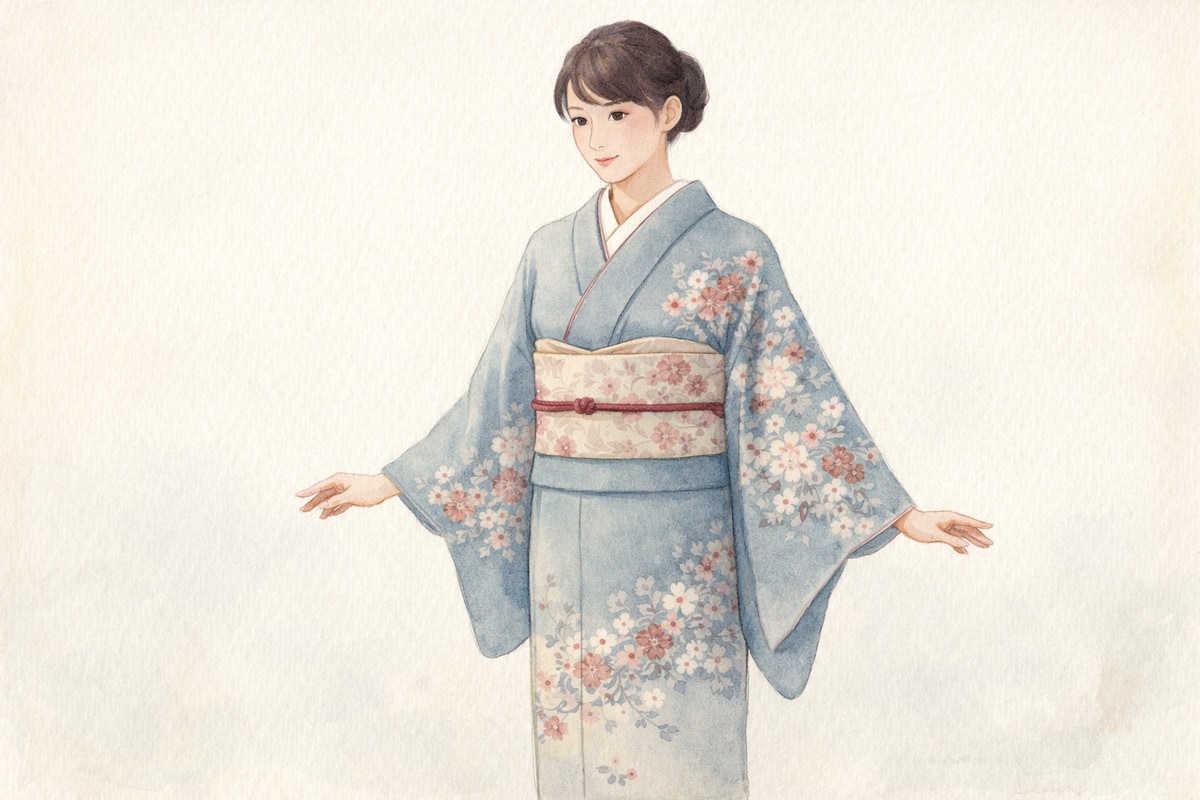
To get straight to the point, the single biggest clue for telling houmongi and tsukesage apart is whether the pattern connects across the seams. On a houmongi, the pattern flows continuously from the shoulder to the sleeve, the chest, and down to the hem, like a single painting. This is called ebamoyou — meaning the pattern forms one continuous picture. A tsukesage, on the other hand, is characterized by a pattern that breaks at the seams or is arranged in scattered, disconnected sections.
For reference, in order of formality from highest to lowest, it goes: houmongi, tsukesage-houmongi, tsukesage, and tsukesage-komon. Once a kimono has been fully sewn, it can be hard to tell these apart at a glance, so it’s worth checking the points below.
The pattern features of houmongi (ebamoyou)
On a houmongi, the pattern is boldly placed across the shoulders, sleeves, chest, and hem, giving the whole garment the gorgeous feel of a single painting. The key point is that the pattern doesn’t break at the seams — it flows continuously. This is because even the hakkake (the lining fabric around the hem) is dyed from the same cloth as the outer fabric, and the pattern on the chest and collar is designed to connect as well. It’s precisely because of this painstaking pattern-matching that houmongi are treated as “semi-formal” kimono of a notably high rank.
Many kimono are dyed while still in the form of tanmono (a bolt of kimono cloth), but houmongi are different: the fabric is first temporarily basted into the shape of a kimono (a state called kari-eba), and the pattern is drawn or dyed onto it at that stage. That’s exactly why the pattern lines up so beautifully once the kimono is properly sewn.
The pattern features of tsukesage
Tsukesage, by contrast, are dyed while still in tanmono form, so the pattern is arranged to avoid falling across the seams. As a result, the patterns tend to be smaller and more contained, or scattered as tobi-gara (motifs spaced out with gaps between them), and they rarely achieve the bold hem designs seen on houmongi. That said, the placement of the pattern is still carefully planned, so that once the kimono is sewn, the pattern appears properly — right side up, never upside down — at key points such as the hem, sleeves, chest, and shoulders.
Interestingly, even though the pattern clearly breaks at the seams up close, a tsukesage can look surprisingly like a houmongi from a distance when worn — which is exactly why first-time viewers often find the two confusing.
Key points for telling them apart
Based on everything above, here’s a summary of what to actually check:
- Does the pattern connect across the seams? If it connects, it’s likely a houmongi; if it breaks, it’s likely a tsukesage
- The density and size of the pattern — bold patterns spreading across the hem and shoulders suggest a houmongi; a lighter, more scattered pattern suggests a tsukesage
- Tanmono or kari-eba — if you’re looking at the kimono before purchase, you can also tell by whether it’s still in bolt form or has been temporarily shaped into a kimono
Laid out this way, you can see that the distinguishing standard really comes down to just one thing: how the pattern connects. Don’t worry — that’s really the only thing you need to remember.
Differences in formality and occasions to wear them
Houmongi and tsukesage are both classified as “ryaku-reisou” (semi-formal kimono), but in terms of rank, houmongi sits one level above tsukesage. For glamorous occasions such as wedding receptions, formal parties, and various ceremonies, a houmongi is considered fitting as a lead-role kind of outfit.
Tsukesage, meanwhile, ranks just below houmongi but above komon (a casual kimono with a small repeating pattern), placing it right in the middle between formal wear and everyday outings. It works well for occasions like tea ceremonies or the theater — settings that call for elegance but not quite the splendor of a houmongi.
If you find yourself wondering, “Would a tsukesage be okay for a formal occasion like a wedding reception?” — rather than going to the trouble of dressing up a tsukesage to raise its formality, it’s simpler to just choose a houmongi from the start. If you’re ever unsure which kind of kimono to choose, it can also help to check a quick-reference guide to kimono types and formality to get a clearer overall picture.
Tsukesage-houmongi: a kimono in between
Finally, there’s one more term worth knowing, just for peace of mind: “tsukesage-houmongi.” This is a kimono designed with the same consideration for pattern direction and placement as a houmongi, but with the pattern connecting across the seams (at points called ai-guchi) in only one or two places — giving it a somewhat lighter impression than a true houmongi. In terms of rank, it sits just below houmongi and above tsukesage.
In recent years, more elaborate tsukesage have appeared with the pattern matched at some of the seams, making many of them hard to distinguish from houmongi at a glance. When in doubt, carefully observing how the pattern connects is still the most reliable method.
In summary
When you boil it down, the difference between houmongi and tsukesage comes down to whether the pattern connects across the seams. A houmongi has an ebamoyou pattern that flows like a single picture from shoulder to hem, while a tsukesage has a lighter pattern that either breaks at the seams or appears in scattered sections. Keep just this one point in mind, and choosing a kimono at a shop becomes much easier.
It also helps to remember the general rule of thumb: houmongi for formal occasions, and tsukesage for elegant but less formal settings like tea ceremonies or the theater. If you’re weighing whether to rent or buy based on how often you expect to wear one, you may also find it helpful to read Renting vs. Buying a Houmongi: How to Choose Based on When and How Often You’ll Wear It.