
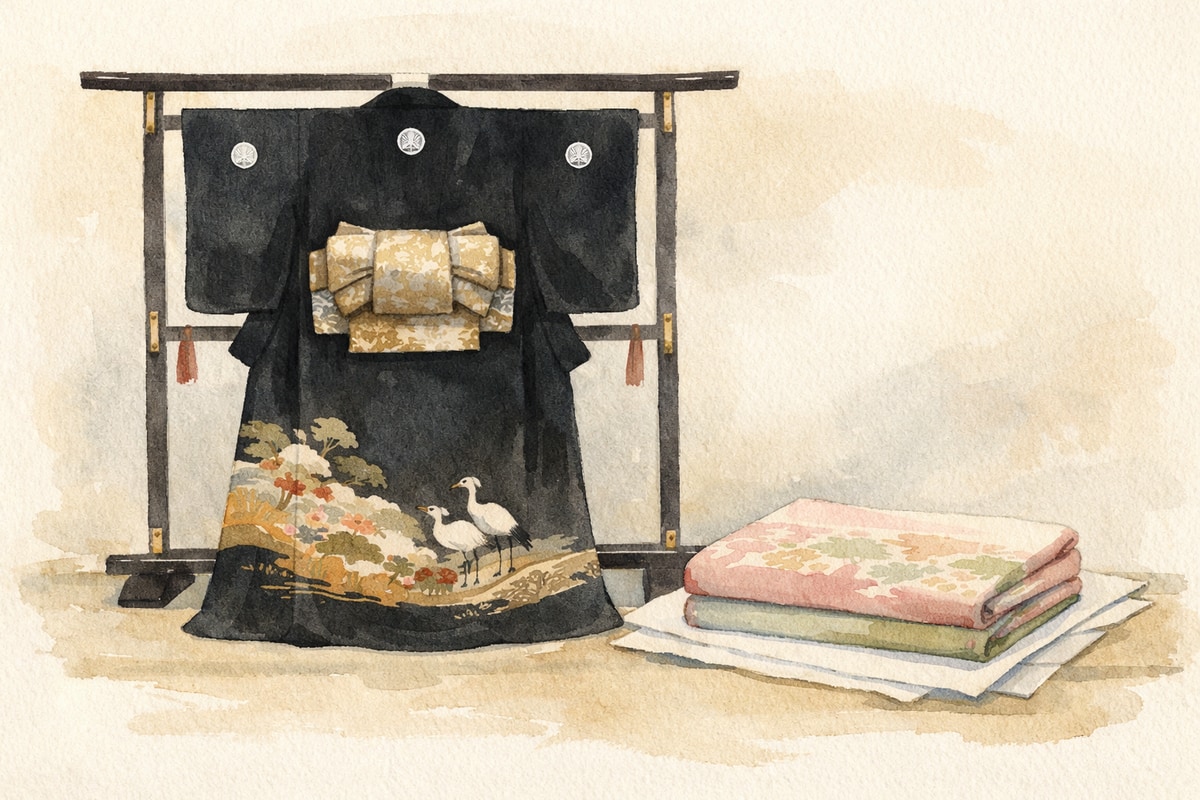
“My sister’s getting married, and I’ve been asked to wear a tomesode (formal kimono for married women worn by close relatives) — but what do I do?” Honestly, this is a question that comes up often here at Iroha. Kurotomesode and irotomesode have a reputation for costing hundreds of thousands of yen, so when it’s finally your turn to wear one, it’s natural to wonder whether renting makes more sense, or whether it’s worth taking the plunge and buying. To cut to the conclusion: the most realistic approach is to decide based on the balance between how often you expect to wear it and your budget. Today, let’s walk through the factors that go into that decision, one by one.
How often will you actually wear a kurotomesode or irotomesode?
A kurotomesode is the most formal attire for married women, while an irotomesode is formal wear that can be worn by married and unmarried women alike. Both are worn mainly at weddings and wedding receptions — they’re not the kind of thing you’d wear in everyday life. It’s worth first getting familiar with the differences between kurotomesode, irotomesode, and houmongi (a semi-formal kimono), which will make it much clearer whether you’re even in a position where a tomesode is the right choice for you. Precisely because these aren’t garments you’d wear more than once or twice a year, many people find themselves torn between renting and buying.
Who tends to be better suited to renting?
At Iroha, our general recommendation is that renting suits people who expect to wear a tomesode just this once, or perhaps only once every several years. Hotel and wedding-venue rentals for kurotomesode typically run around ¥40,000–¥80,000; regional hotels or venues tend to be ¥20,000–¥60,000, while higher-ranked hotels run ¥30,000–¥100,000 as a rough guide. Irotomesode rentals sit at roughly the same level, with regional venues at ¥20,000–¥60,000, higher-end hotels at ¥30,000–¥100,000, and online rentals ranging more widely from about ¥10,000–¥50,000. Some sources put home-delivery rentals for kurotomesode specifically at around ¥20,000–¥40,000, so prices vary considerably depending on which channel you use. Not having to worry about storage or upkeep afterward is also a real plus for those who lean toward renting.
Who tends to be better suited to buying?
On the other hand, buying becomes a real option for those with multiple daughters or sons who expect to attend family weddings as a relative for years to come, or for those who simply want to own one piece bearing their own family crest for the long term. At specialist kimono shops (gofukuten) or department stores, kurotomesode are typically priced from about ¥200,000 to ¥1,000,000, with the most commonly sold range falling between ¥300,000 and ¥600,000. Online retailers tend to be a bit more accessible, with a central price range of roughly ¥100,000–¥500,000. Buying is by no means a small purchase, so it’s worth taking a moment — and this is really the crux of the decision — to jot down on paper roughly how many occasions you’re likely to wear it for in the years ahead.
How your role at the event changes the calculation
If you’re attending as the mother of the bride or groom, many people choose to buy, with the idea of using a formal kurotomesode bearing five crests (itsutsu-mon) for years to come. If you’re attending as a friend or acquaintance in a guest role, however, it’s often more practical to have an irotomesode made with three crests (mitsu-mon) or a single crest (hitotsu-mon), so it can also be worn for other occasions beyond weddings — entrance ceremonies, tea gatherings, and the like. The number of crests represents a trade-off between formality and versatility: five crests bring the same level of formality as a kurotomesode, but that limits the occasions where it can be worn. Three crests or a single crest, by contrast, can be worn across a wider range of settings, from wedding receptions to entrance ceremonies, which is reportedly why more people are choosing this option in recent years. If you’d like to understand crest conventions in more depth, How Do Five, Three, and One Crests Change a Kimono’s Formality? is a good place to look. Incidentally, a kurotomesode is required by convention to always carry five crests as the most formal attire, and it isn’t acceptable to reduce this to three or one. This is a key difference from irotomesode, so it’s worth keeping in mind.
Rough guide to booking timing if you choose to rent
Once you’ve decided to rent, the next question is timing. Don’t worry — there are really only two things to remember. First, book no later than one month before the wedding. Second, ideally, start comparing shops and trying pieces on about two months ahead, so that you’ve settled on the tomesode you’ll wear by the one-month mark. Popular patterns and colors are said to sometimes get booked out as far as two months in advance, so it’s especially reassuring to start early during the spring and autumn wedding seasons. That said, some say booking six months or a year ahead isn’t necessary, so there’s no need to rush. It seems that in some cases, booking just 10 days ahead can still work out, but given the need to also schedule a fitting, aiming for around one month ahead is the safer bet.
Points to check if you choose to buy
If you decide to buy, the first essential step is settling on the number and type of crests. A kurotomesode calls for five crests without exception, but with an irotomesode, whether you go with three crests, one crest, or five crests depends on which occasions you mainly expect to wear it for. If you choose a five-crest irotomesode, note that it will be tailored in the same hiyoku style (a double-layered finish) as a kurotomesode — this is worth confirming before tailoring begins. Also, since buying tends to involve a significant sum, keep in mind that there can be quite a gap in price between specialist kimono shops or department stores and online retailers. It may also help to ease the psychological hurdle of buying if you’re aware of your options for parting with the piece down the line — Types of Kimono Buyback Services and How to Choose One covers this in more detail.
In summary
Whether to rent or buy a kurotomesode or irotomesode ultimately comes down to a single question: “How many more occasions am I likely to wear this for?” If it’s just for this one occasion, renting is more than sufficient, and the cost will most likely fall somewhere between ¥20,000 and ¥100,000. If, on the other hand, you expect to keep attending family weddings as a relative, it may be worth considering a purchase, with ¥300,000–¥600,000 as a rough benchmark. Whichever you choose, settling on the number of crests and the booking timing early on will help you avoid a last-minute scramble on the day. If you’re still unsure which way to go, it may also help to take a broader look at Kimono: Is Renting or Buying Better?.