
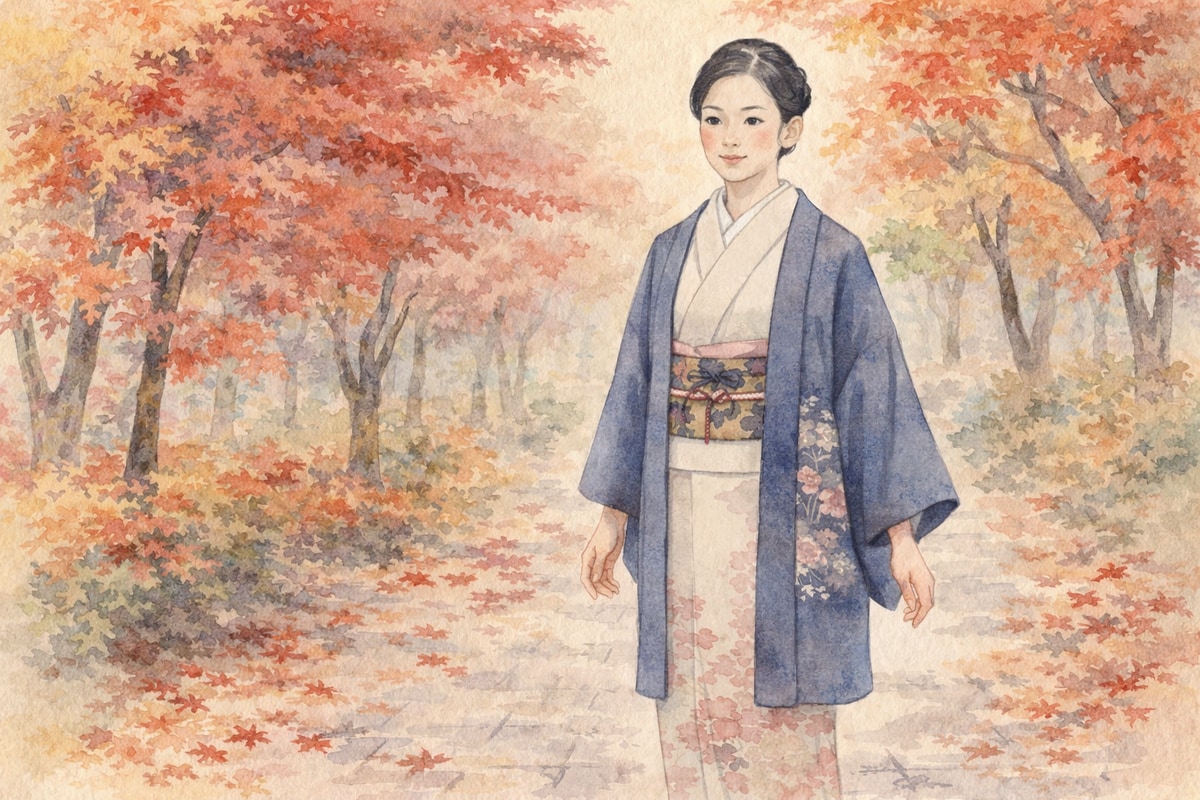
When you decide to go autumn leaf-viewing in kimono, there’s a good chance you’ll pause at one particular question — do you need a haori (a short kimono jacket), or should you go as far as preparing a michiyuki coat (a kimono-style coat)? This article is written for exactly that moment of hesitation. It’s a worry that belongs specifically to late October, when autumn is still young.
Late-October temperatures and how they actually feel
Statistics show Tokyo’s average October temperature is around 19°C, and Chiba’s is about 18.2°C (with an average high of 22°C and an average low of 14.4°C). Numbers like these sound comfortable enough, but leaf-viewing means being outdoors and walking for long stretches. The difference between sun and shade, morning and evening, can be dramatic, and as November approaches, the gap between day and night temperatures only widens.
In formal settings, late October is considered the proper time to switch to awase (lined kimono), yet the actual temperature can still be mild enough for an unlined hitoe on some days. In other words, the cut of the kimono alone can’t absorb these temperature swings — and that’s exactly the challenge of late-October leaf-viewing.
Haori versus michiyuki coat: how to choose
At their core, the haori and a kimono coat serve different purposes. A haori is worn open at the front and is, in a sense, more about styling than shielding. It offers light warmth, but because the front stays open, it can’t block the wind the way a coat can. One nice thing about a haori is that you can keep it on indoors without needing to take it off.
A kimono coat, on the other hand, covers everything from the collar to the cuffs, and its main job is to keep cold air out. A haori is often enough for the mild chill of spring or autumn, but on mornings and evenings with a sharp cold snap, or at windy leaf-viewing spots, many people find a coat more comfortable. For more on telling a haori and michiyuki coat apart, and how to handle them indoors, see Haori vs. Michiyuki Coat: What’s the Difference? A Simple Guide Based on Whether You Take It Off Indoors.
So which one should you actually choose?
In late October, a haori will usually get you through a day of leaf-viewing centered on strolling through town. But if you’re headed to a mountain destination, or planning to walk from early morning until evening, it’s worth bringing a coat for peace of mind. When in doubt, a simple way to decide is by how easy the garment is to put on and take off. A haori can be slipped off quickly and folded small, while a coat takes a bit more effort to get in and out of.
Preparing for a day of long walks
Besides a haori or kimono coat, people often mention bringing a neck scarf, tabi liners, and disposable heat packs when heading out for leaf-viewing. Feet tend to feel the cold especially quickly in kimono. Simply layering a liner under your tabi socks can make a noticeable difference in comfort.
If you’d also like to prepare for ease of walking, managing your hem, and avoiding stains, Heading Out in Kimono for Autumn Leaves? Tips for Easy Walking and Stain Prevention is a good resource. Thinking ahead not just about staying warm, but also about fallen leaves and mossy paths underfoot, can put your mind much more at ease on the day itself.
Layering that’s easy to adjust
During a season of such wide temperature swings, it helps to tuck a thin shawl into your bag along with your haori. A shawl feels less formal than a haori, and simply draping it over your shoulders eases the chill — making it easy to slip off, too, when you stop at a tea house for a break. Carrying an extra item might feel like a small burden, but it’s far less stressful than suddenly finding yourself cold with no way to warm up.
Take off the haori in the sun, drape the shawl over your shoulders in the shade — these small adjustments, made one after another, may be the real secret to enjoying the day in comfort.
In summary
For late-October leaf-viewing, a haori is often enough if you’re mainly strolling through town, while a michiyuki coat is worth considering for mountain destinations or a full day of walking — that’s the answer that emerges from the temperature data and basic principles of staying warm. Combine a haori with a shawl wisely, and you can keep the hassle of layering to a minimum. By the time you’re walking beneath the colored leaves, it’s the beauty of the foliage, not the cold, that will likely stay with you.