
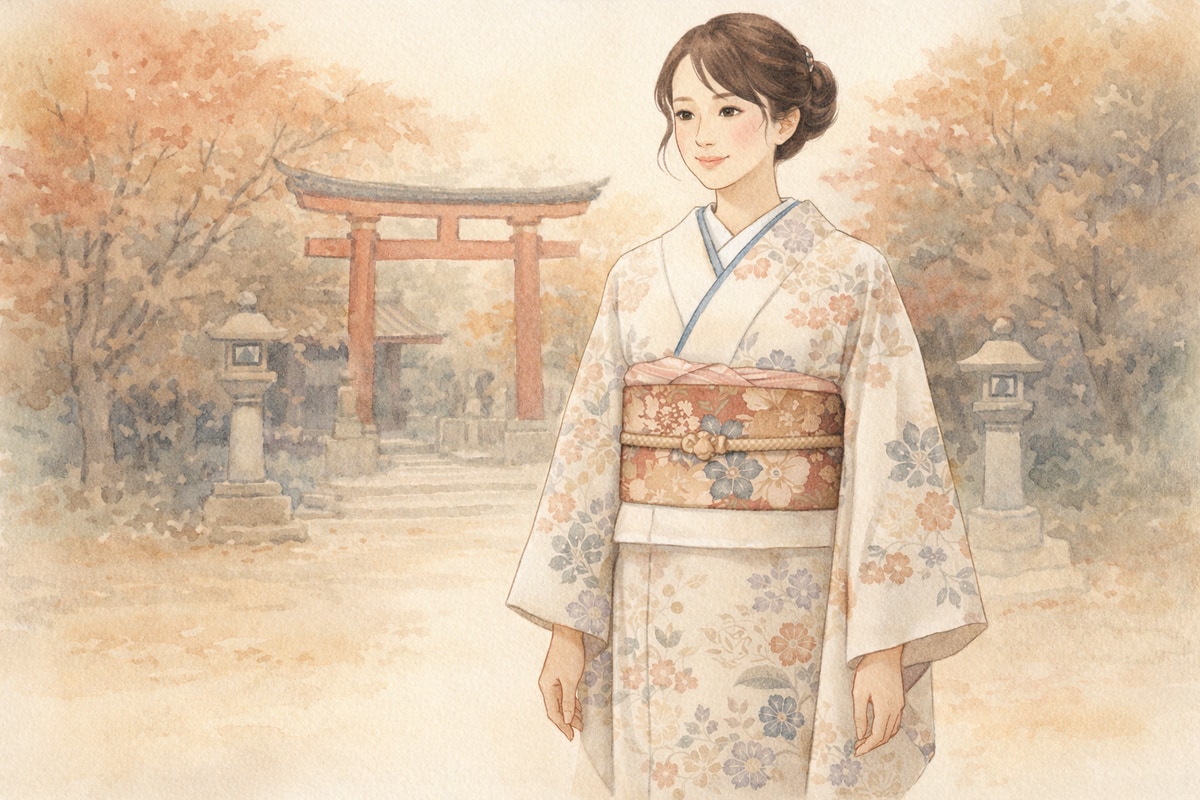
You’ve finally settled on a houmongi (a semi-formal kimono) for Shichi-Go-San (a celebration for children aged 7, 5, and 3) — and then the color of the obijime (a cord tied over the obi) and obiage (a fabric accent above the obi) stops you in your tracks. Sound familiar? At the kimono shop, picking the tanmono (a bolt of kimono cloth) and obi (the wide sash tied around a kimono) feels manageable, but the small accessories suddenly make you second-guess yourself. Don’t worry — there are only a few key points to keep in mind when choosing obijime and obiage colors. This article walks mothers wearing a houmongi to Shichi-Go-San through how to decide on those colors, step by step.
Thinking About Color While Keeping the Houmongi’s Formality
First, it helps to remember that houmongi rank just below kurotomesode and irotomesode as semi-formal wear. It’s a versatile kimono that can be worn regardless of age or marital status. Pale-colored houmongi are popular for Shichi-Go-San, and pink in particular is considered modest and elegant.
That same ‘modest and elegant’ direction applies directly to your obijime and obiage. If you want to preserve a sense of formality, you can’t go wrong choosing an obijime with gold or silver thread, and an obiage in either a pale shade or one with gold or silver thread. Since the nagajuban (an under-kimono) is typically white as well, the trick to keeping a houmongi’s dignity intact is to avoid making the accessories too flashy and instead tie everything together with refined colors.
Incidentally, houmongi, tsukesage, iromuji, and Edo komon are all considered appropriate choices for mothers at Shichi-Go-San. If you’re still deciding on fabric or pattern, you might also find this article helpful: Shichi-Go-San Mother’s Kimono: Houmongi or Iromuji? How to Decide When You’re Torn.
Balancing Colors With Your Child’s Kimono
Once formality is settled, the next thing to think about is color balance with your child. The basic rule is that the mother’s kimono should be less eye-catching in color and pattern than the child’s festive outfit. Beyond that, bringing a touch of the child’s kimono color into your obijime and obiage instantly makes the parent-child coordination look more stylish.
The approach is simple: just work a hint of your child’s kimono color into your obiage, obijime, or kasane-eri (a decorative layered collar). For example, if your child’s kimono is purple, slip a pale purple into your obiage or haneri (the inner collar). That alone creates a subtle sense of connection. There are real examples of cream-colored houmongi paired with pale yellow-green obijime and obiage — pulling the color from within the houmongi’s pattern tends to make the whole look cohere.
Other real examples include pairing a pale pink houmongi with pink-toned obiage and obijime, or using mint blue as an accent against a black-and-gold obi. If you’d like to review the basics of obijime and obiage color coordination in one place, this article is worth a look too: How to Choose Obijime and Obiage: The Basics of Formality and Color Matching.
Color Combinations to Avoid
By now you probably have a sense of the two guiding principles: ‘lean toward your child’s colors’ and ‘keep things in pale tones.’ So are there color combinations best avoided?
First, for the obiage, choose rinzu (a glossy, smooth silk fabric) rather than casual options like patterned chirimen or sohshibori. For the obijime, a flat-braided (hira-gumi) style gives a calmer, more composed impression.
Another thing worth remembering: extra care is needed when the houmongi itself is in a chic, subdued color like black or deep navy. In that case, pairing it with a fukuro obi featuring gold or silver thread keeps the look from feeling too plain while adding elegance. On top of that, introducing one bright color into the obiage or obijime brings a festive brightness to the whole outfit. On the other hand, if you layer only subdued accessories onto an already chic kimono, the overall impression can end up looking subdued despite it being a celebratory occasion. This is a point worth watching carefully.
Adding a Touch of Seasonal Feeling
Since Shichi-Go-San mainly takes place in November, it’s a nice touch to bring a little autumn feeling into the obi and accessories. Rather than going all-out festive the way you might for a wedding, the idea is to choose a houmongi with a restrained pattern and gentle coloring, then quietly weave in a sense of the season.
If you’d like to express seasonal feeling through the patterns or monyou (a traditional motif) on your obijime and obiage, it may help to look at the kimono’s overall coordination as well. Once you’re more comfortable with formality levels and choosing accessories, selecting seasonal patterns like this becomes one of the fun parts of the process.
Summary
When choosing obijime and obiage for a houmongi at Shichi-Go-San, keep these three principles in mind: 1) lean toward pale colors or gold/silver thread to preserve a sense of formality, 2) incorporate one touch of your child’s kimono color, and 3) add a bright accessory as an accent if your houmongi is in a chic, subdued color. With these three points, choosing becomes much easier. If you were stuck at the start of this article, these guidelines should help the right obijime and obiage colors click into place. On the day itself, enjoy the way your colors echo your child’s.