
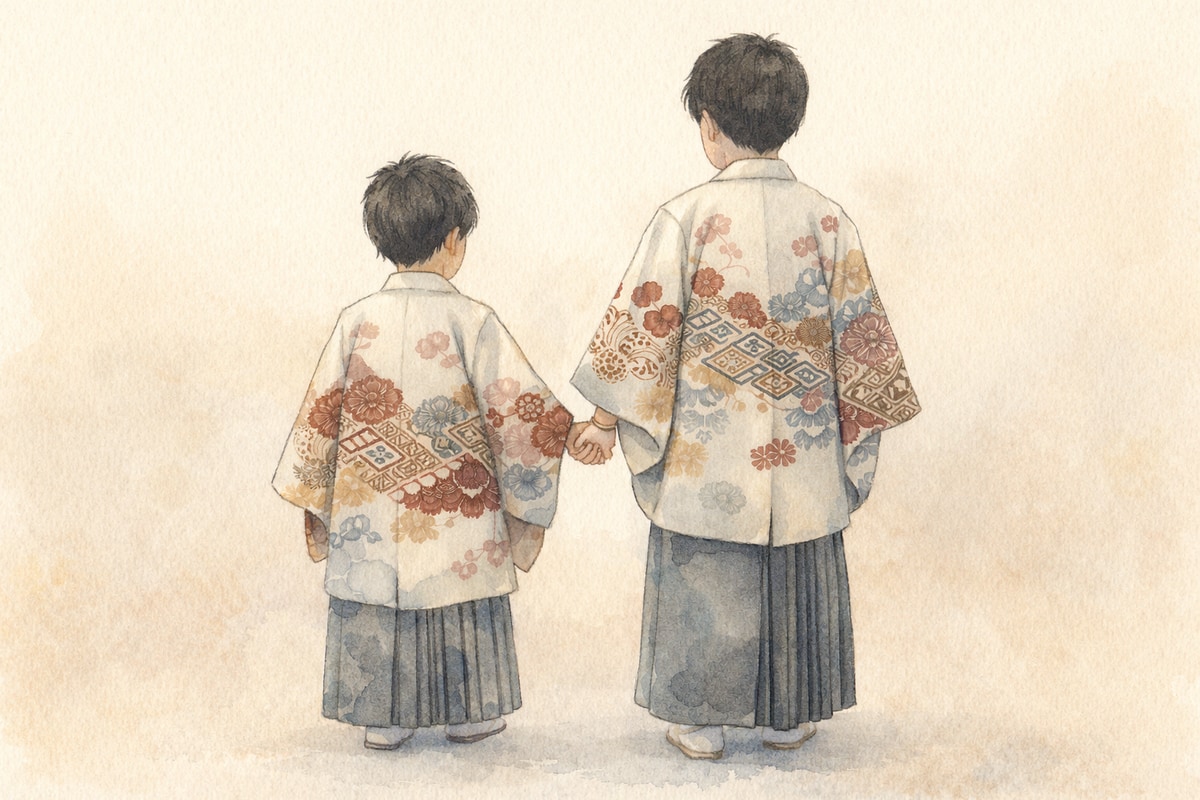
“Could the kimono our older child wore for Shichi-Go-San (a celebration for children aged 7, 5, and 3) be passed down to the younger one?” If you have two or three children, this is probably a thought that’s crossed your mind at least once. It feels like such a waste to use a carefully chosen kimono only one time, and that feeling is completely understandable. That said, how much a kimono can be handed down really depends on the age gap and gender of the children involved. In this article, we’ll work through whether a Shichi-Go-San kimono can be passed between siblings, looking at both size and pattern.
To get straight to the point, hand-me-downs work most smoothly when the children are in the same age bracket (both age 3, or both age 7) and are close in gender as well. Passing a kimono across age brackets is difficult because the garments themselves are cut differently, and when genders differ, the real obstacle tends to be the impression made by pattern and color rather than any issue with how the kimono is worn.
Combinations Well Suited to Hand-Me-Downs
Shichi-Go-San kimono are tailored very differently depending on age. A 3-year-old wears a mitsumi (a kimono cut for toddlers), while a 7-year-old wears a yotsumi (a kimono cut with four main panels) — two completely different sets of measurements. This is where the dividing line falls.
- Between two 3-year-olds (older sister to younger sister, older brother to younger brother, etc.): A mitsumi kimono can absorb differences in build through kata-age (a shoulder tuck, adjusting the yuki, or sleeve length from center-back to wrist) and koshi-age (a waist tuck adjusting the mitake, or overall length), which makes it well suited to being passed down.
- Between two 7-year-olds: A yotsumi has enough range built in to fit children from roughly age 5 to 10, so this pairing is also fairly easy to adjust and reuse.
- Passing a 3-year-old’s kimono to a 7-year-old: A mitsumi simply won’t be long enough, since a 7-year-old needs a yotsumi. This combination isn’t realistic.
- Passing a 7-year-old’s kimono to a 3-year-old: A yotsumi is far too large for a 3-year-old’s frame, so this combination is also difficult.
In short, if you’re considering hand-me-downs, the basic rule is to re-adjust the measurements within the same age bracket. As a side note, a kakegi (a baby’s ceremonial robe) used for the newborn shrine visit (omiyamairi) can be re-tailored for a 3-year-old’s Shichi-Go-San, but a 7-year-old’s kimono is built just like an adult’s, so altering a kakegi for that age isn’t recommended. These age-based differences are covered in more detail in Shichi-Go-San Kimono and Preparation Checklists for Ages 3, 5, and 7.
What About When Genders Differ?
Even when siblings are close in age, what are the chances of a successful hand-me-down if their genders differ? Let’s work through this step by step.
The hifu (a padded vest-like overgarment) commonly worn for a 3-year-old’s Shichi-Go-San is actually built almost identically for boys and girls. The basic combination of kimono, heko obi (a soft, single-cloth sash), and hifu is shared across genders, and the level of difficulty in dressing is the same either way. In fact, one reason many families choose the hifu style over hakama (traditional trousers) is precisely because it’s easier to dress a child in. Looking at construction alone, passing a kimono between genders isn’t impossible.
The real obstacle, however, is pattern and color. Girls’ kimono tend to favor warm tones such as red, pink, and light blue, with elegant monyou (traditional motifs) like bundled noshi (ceremonial paper strips), temari balls, bells, butterflies, hanaguruma (flower carts), and goshoguruma (courtly ox-carts). Boys’ kimono, on the other hand, favor calmer tones such as navy, gray, black, and indigo, with bold motifs like takarazukushi (an assortment of lucky treasures), helmets, dragons, and hawks. While the construction may be shared, the tendencies in color and pattern are clearly divided along gender lines. This varies by family, of course, but if your younger child is a different gender, it’s more practical to prioritize the impression made by the pattern over simply reusing the construction.
How Far Can Resizing Go?
Once you’ve settled on a hand-me-down within the same age bracket and gender, the next question is exactly how much resizing is possible. Let’s look at the specifics.
Children’s kimono are originally tailored with kata-age and koshi-age built into the design. Kata-age adjusts the yuki (the sleeve length from center-back to wrist), while koshi-age adjusts the mitake (the kimono’s overall length) — both are done without fail for 3- and 5-year-olds, while for 7-year-olds, kata-age is always done and koshi-age is done as needed. In other words, the system is built so that differences in build between siblings can be absorbed to some extent simply by re-sewing the tucked-in fabric (age). The nagajuban (an under-kimono) is adjusted the same way, through kata-age and koshi-age, and for a 3-year-old, attaching a han-eri (a half-collar) is also needed.
As a reference, here are some example measurements by age.
| Age / Gender | Approximate Height Range | Mitake | Yuki |
|---|---|---|---|
| 3-year-old girl | Approx. 90–100cm | 75cm | 42cm |
| 3-year-old boy | Approx. 90–100cm | 76cm | 42cm |
| 5-year-old boy | Approx. 100–110cm | 71.5cm | 45cm |
Even with a kimono that hasn’t had koshi-age done, the hem length can often be adjusted at the time of dressing using the ohashori (the fold tucked at the waist), so if the difference in build is small, it may be possible to make do without any re-sewing at all. Adjusting the yuki is generally considered a fairly simple alteration, and adjusting the mitake isn’t difficult either, as long as there’s enough seam allowance or the change is to shorten it. If you’re unsure, the surest approach is to bring the kimono in question to a shop and have them check exactly how much allowance there is to work with. For more on the specifics of resizing, see How Far Can You Adjust a Kimono’s Mitake and Yuki?.
Things to Watch for in Pattern and Color
Even when the size works out, many parents still find themselves unsure when it comes to choosing a pattern. That’s because the difference in patterns between age groups is bigger than it might seem.
A 3-year-old wears a mitsumi, while a 7-year-old wears a yotsumi, and there are charming patterns meant only for age 3, just as age 7 brings patterns with a brilliance that rivals even a furisode (a long-sleeved formal kimono). The bundled-noshi motif, a classic choice for girls, is a good example of how dramatically the feel of a pattern can shift with age. If an older child’s yotsumi, tailored for their own 7-year-old Shichi-Go-San, is later worn by a younger sibling also at age 7, there’s no issue at all. But the idea of putting “a charming pattern meant for age 3” on a 7-year-old doesn’t sit well — not just because of size, but because the pattern itself feels like the wrong age.
The color tendencies between genders, as mentioned earlier, are also quite distinct. Girls’ kimono center on red, pink, light blue, primary colors, and white, while boys’ kimono favor black, blue, green, and indigo — and this holds true whether the pattern is classic or modern in style. With photographs in mind, it’s fair to say that passing a kimono between genders tends to leave the overall impression feeling mismatched.
In Summary
When it comes to passing down a Shichi-Go-San kimono between siblings, the smoothest combination by far is the same age bracket and the same gender. Crossing age brackets means the kimono itself is cut differently, and crossing genders tends to raise doubts around pattern and color. As for size, kata-age, koshi-age, and adjustments to the yuki and mitake offer more flexibility than you might expect. If you’re ever unsure, it’s worth bringing the kimono to a shop to have them check both how much allowance there is for resizing and how the pattern reads for the child’s age. Seeing siblings dressed together in their formal kimono is, in itself, a wonderful family memory in the making. If you’re trying to decide whether renting or buying makes more sense for reuse across siblings, you might also find it helpful to look at Renting vs. Buying a Shichi-Go-San Kimono: A Guide to Reuse and Storage for Ages 3 and 7.