
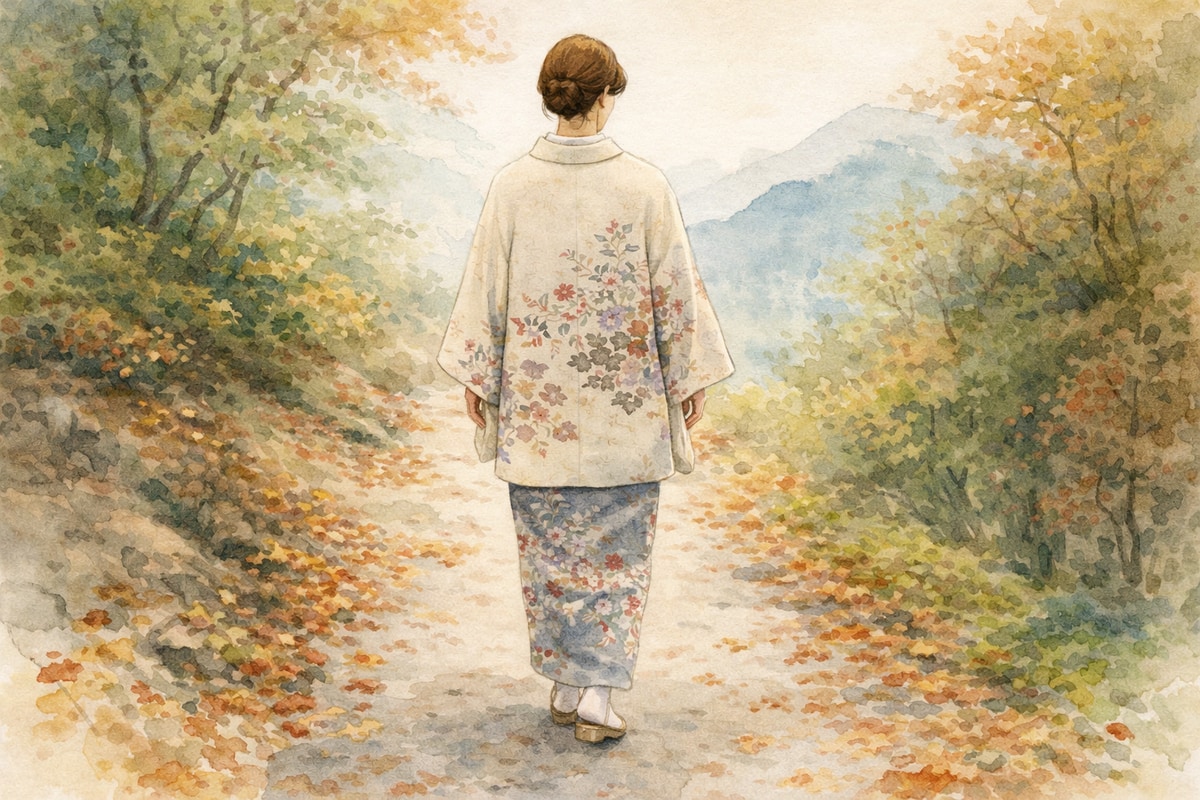
You want to walk through mountains ablaze with color. But will the slopes be too hard in kimono? Will the hem get dirty? These are exactly the worries that those who most want to go leaf-viewing in kimono tend to carry. The short answer: as long as you get three things right—fabric, footwear, and outerwear—you can absolutely walk mountain paths for autumn leaf-viewing in kimono. So settle in, listen for the crunch of fallen leaves underfoot, and read on at your own pace.
Kimono fabrics suited to the occasion
Leaf-viewing means a long day of walking outdoors. The first thing to think about is how easily the fabric itself lets you move. Lighter materials and kimono cut for ease of movement work well, and when in doubt, wool is considered the most walkable choice. Wool is warm yet breathable, making it comfortable even in the cool autumn air outdoors. Sturdy, easy-care fabrics like tsumugi (a textured, hand-woven silk) or cotton are also well suited to leaf-viewing. The fact that you can wash and care for them yourself to some extent is one more reason to wear them without worry.
As for construction, autumn calls for a lined kimono called awase. This is the style worn during the cooler months from roughly October to May, and it’s well suited to retaining warmth during the morning and evening chill of autumn leaf season. A tsumugi awase, with its slubbed threads adding natural character, has an endearing quality all its own—it’s easy to see why it’s said to suit scenes of enjoying nature so well.
Choosing colors and patterns, and footwear tips
Once you’ve settled on fabric, the next considerations are color, pattern, and footwear. A casual everyday kimono is easier to move in and puts you more at ease than a formal houmongi (a semi-formal kimono). If you’ll be outdoors for a long stretch, choosing a color that won’t show dirt easily is a reassuring choice. Rather than picking something bold enough to compete with the reds and yellows of the foliage, a slightly subdued tone may actually be just right.
For footwear, if you’re wearing zori (flat kimono sandals), choosing a cushioned type will keep you from tiring even after walking for a long time. Boots are an option for days when rain seems likely, though this is really more of a technique for those already comfortable in kimono. Since some leaf-viewing spots involve a lot of sloped terrain, it’s reassuring to research the route in advance if you’re unsure about the walking conditions. How well zori hold up against moisture and dirt depends on the material. Can geta (wooden sandals) and zori be washed with water? How to tell water-resistant materials from delicate ones, and how to care for them is worth a look before you head out.
You can also build in a small adjustment at the kitsuke (dressing in kimono) stage: having the hem dressed slightly shorter than usual keeps it from getting in the way while walking. If you know you’ll be on mountain paths, it’s worth mentioning this detail when you’re being dressed.
Places that attract dirt, and how to handle them
The biggest worry during leaf-viewing is, naturally, mud. Walking across grassy areas or mountain trails often means soil ending up on the hem. The key thing to remember here is to let mud dry before removing it. If mud gets on the fabric, let it dry completely, then brush it off once dry. Rubbing it while still wet will push it deeper into the fibers, so this is one point where patience really pays off. For the extra care needed once you’re home, What should you do after wearing kimono? What you can do at home versus when to use professional cleaning is a helpful reference.
There’s also the option of preventing stains from taking hold in the first place. Among washable kimono, some fabrics are treated for anti-static, stain-, water-, and oil-resistance, making them less likely to pick up dirt and easier to clean if they do. On a day like leaf-viewing, when you’ll be outdoors for long stretches, choosing this kind of fabric can give you real peace of mind.
Outerwear for warmth
November brings a big swing in temperature between day and night. You might work up a sweat during the day, only to feel a sudden chill as evening sets in. This is where a haori (a kimono overcoat) that’s easy to put on and take off becomes invaluable. Take it off when you warm up while walking, put it on again when shade or dusk brings a chill—having one piece you can adjust to the temperature is the basic principle of staying warm during leaf-viewing. A wool haori in a single-layer (unlined) cut is said to be perfect for a light outing like this.
A small story for today’s outfit
The slubs in tsumugi, the softness of wool, a hem dressed just a touch shorter—each is a small adjustment made for walking mountain paths. The more you learn, the clearer it becomes that kimono isn’t reserved only for special occasions. Choose the right fabric, prepare your footwear, and bring along a haori—with just that much, the autumn mountains will likely welcome you more gently than you expected. As the unlined-kimono season ends and the mountains quietly begin to turn color, walking through that scenery in kimono is, in its own way, a wonderfully stylish thing to do.