
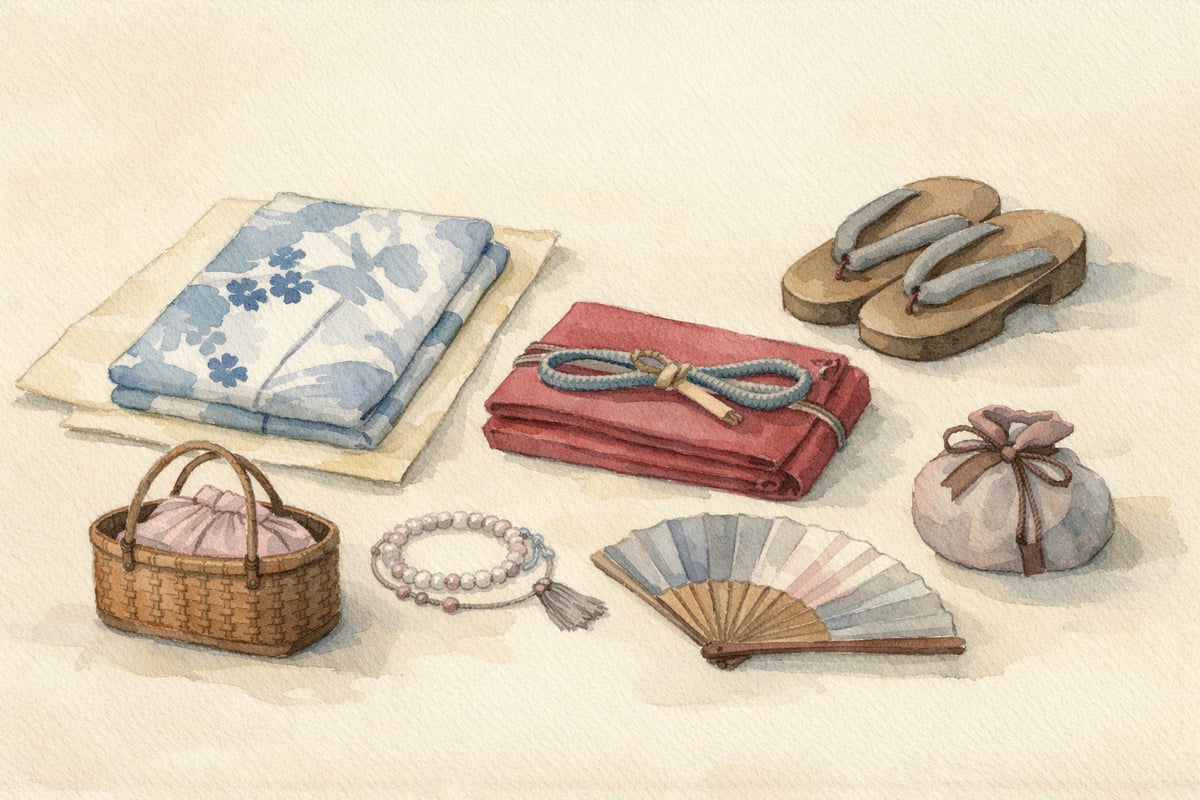
The obi lined up in yukata sections are usually hanhaba obi or heko obi. And yet, if you watch kimono enthusiasts in summer, you’ll sometimes spot a Nagoya obi (the obi typically worn with kimono) tied over a yukata (a light cotton summer kimono) — which can feel a bit surprising. This isn’t really a matter of choosing between hanhaba obi (a narrow half-width sash) and a Nagoya obi. It’s a more advanced way of styling yukata to look like a summer kimono. Once you understand where that line is drawn, choosing an obi becomes much less confusing.
The basics for yukata are hanhaba obi and heko obi
The first thing to keep in mind is that the obi used for everyday yukata styling are the hanhaba obi and the heko obi. As the name suggests, a hanhaba obi is tailored to half the width of a Nagoya obi or fukuro obi. It’s the most common obi for yukata, and its crisp fabric gives a neat, put-together look. It also comes in plenty of tying variations — a bunko knot or a ribbon knot, for example — so you can change things up depending on your mood that day.
A heko obi is made of thin, soft fabric, and was originally worn widely by children. These days more adult versions are available too. It creates a soft, voluminous shape, so it looks finished even with a simple tie. If you’re unsure, start with a hanhaba obi. Once you learn how to tie it, you can use it for years, and you’ll rarely struggle with how it balances against a yukata. For a detailed comparison of whether a hanhaba obi or a heko obi suits you better, see [Yukata Obi: Hanhaba Obi or Heko Obi? Differences in Ease of Tying and Appearance].
A Nagoya obi isn’t an equal alternative to the hanhaba obi
So where does the Nagoya obi fit in? A Nagoya obi is, by nature, an obi meant to be paired with kimono — komon (a casual kimono with a small repeating pattern) or tsumugi (a textured, hand-woven silk), for instance. While a hanhaba obi is complete on its own without an obijime (a cord tied over the obi) or obiage (a fabric accent above the obi), a Nagoya obi is tied into an o-taiko (drum-shaped) knot and finished with both an obijime and obiage. That means one more step, and one more set of items, added to the process.
As a result, wearing a Nagoya obi naturally pulls the whole look closer to kimono styling. This is exactly where you get the odd effect of a yukata that doesn’t quite look like a yukata anymore. Only the obi has a kimono-like formality, while the yukata itself, the footwear, and the collar area all stay casual — and it’s this mismatch that fuels the question of whether a Nagoya obi really belongs with a yukata. So rather than thinking of the Nagoya obi as an equal choice alongside the hanhaba obi — as in, ‘which one today?’ — it makes more sense to think of it as an option for reworking the entire look toward kimono styling. For more on the Nagoya obi’s own background, see [Nagoya Obi vs. Fukuro Obi: Differences and How to Use Them].
What kimono-savvy people actually adjust when they pair a Nagoya obi with yukata
Still, some people do wear a Nagoya obi with yukata, because there’s a way of dressing yukata to look like a ‘summer kimono.’ What matters here is that they’re not just swapping the obi. The more experienced someone is, the more likely they are to be adjusting all of the following together:
- The yukata’s material and construction — thin, semi-sheer fabrics like cotton ro (a sheer, gauzy summer silk) weave, cotton kōbai, or cotton-linen blends are said to suit being paired with a nagajuban (an under-kimono). Plain-weave momen (cotton) or crepey shibori, on the other hand, show their character best worn alone, simply
- The collar area — pairing with a nagajuban or an undergarment with a half-collar attached, and shaping the collar (eri) with a collar stiffener
- Footwear — switching from bare feet in geta (wooden sandals) to tabi socks with zori (flat kimono sandals)
- Around the obi — choosing a summer-appropriate Nagoya obi and adding an obijime and obiage. It’s suggested that the obiage be more understated than it would be with kimono, and the obijime slimmer
- Timing and destination — as a rough guideline, this works up until around early October, the season for unlined awase-style kimono; since it isn’t suitable for every occasion, it helps to check the mood of your destination beforehand
In other words, this isn’t just a matter of dressing skill — it only comes together once the material, collar, footwear, obi styling, and destination are all aligned. Put another way, if you can manage all of that, the result is a look that’s elegant and distinctly grown-up. For more on sheer summer fabrics themselves, see [Ro, Sha, and Asa: The Cool Elegance Hidden in Sheer Kimono].
For summer festivals and fireworks displays, a hanhaba obi is easier to manage
On days when you’re heading somewhere crowded, a hanhaba obi is simply the easier choice. There are several reasons. One is that it’s light and easy to move in. Another is that you can adjust the look just by changing how you tie it. And perhaps most importantly, it’s easy to fix yourself if the kimono starts coming loose (kizukure). An o-taiko knot has a fixed shape, so once it comes undone, it’s hard to redo in public.
Your feet can stay comfortably in geta, too, and you’ll have fewer things to carry. Summer festivals and fireworks displays tend to involve a lot of walking and waiting around, so traveling light translates directly into having more fun. For more on the small items worth bringing along on summer outings, see [Accessories to Bring for Summer Kimono and Yukata: Thinking Through Parasols, Fans, and Basket Bags].
If you’re tempted to try a Nagoya obi, here’s what to check
If you feel like giving it a try, stand in front of a mirror and go through the following, in order. If even one point gives you pause, it’s safer to stick with a hanhaba obi that day.
- Does the yukata itself look out of place and too casual (has the obi ended up dressed for kimono while the yukata stays dressed for a summer festival)?
- Does the obi alone look too heavy or formal?
- Is the fabric right for the season (is it actually a summer-weight obi)?
- Does it suit the mood of where you’re going?
- If it comes loose, can you fix it yourself?
If you’re not confident about coordinating the obijime and obiage, [Choosing Obijime and Obiage: The Basics of Formality and Color Matching] can serve as a guide.
In summary
The conclusion is simple. The basic obi choices for yukata are the hanhaba obi and the heko obi. Whether it’s your very first obi or you’re heading out to a summer festival or fireworks display, choosing from these two will rarely steer you wrong. A Nagoya obi is neither essential, nor is it a common either-or alternative alongside the hanhaba obi. Rather, it’s positioned as an obi that some people choose to tie once they’ve also adjusted the yukata’s material and construction, added a nagajuban and tabi, chosen a summer-weight obi, and considered their destination — for those who want to dress their yukata like a summer kimono.
So the first step isn’t ‘which obi should I choose,’ but rather deciding whether you’re dressing as yukata today, or leaning toward kimono styling. Once that’s decided, the obi will follow naturally.