
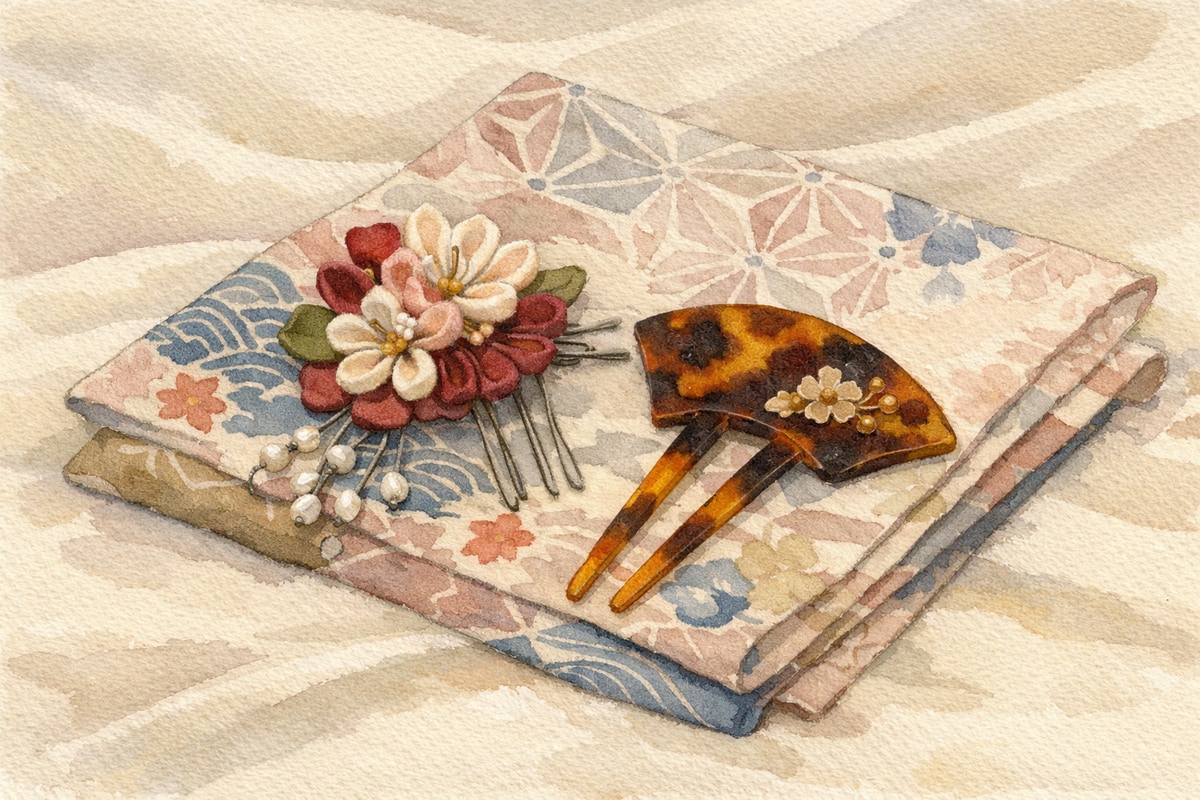
Standing in front of a kanzashi (a decorative hair ornament) display case, have you ever noticed how different the pieces look — some made of soft, folded fabric flowers, others gleaming in a warm amber color — and wondered which to choose? These two types are actually completely different from the ground up. One is handcrafted from folded fabric, while the other has traditionally been made from the shell of a sea creature. Today, let’s go over what’s worth knowing about these two materials so choosing becomes easier.
Tsumami Zaiku Is Handcrafted from Fabric
Let’s start with the fabric kanzashi. Tsumami zaiku is a craft where small squares of fabric are pinched with tweezers and folded into the shape of flower petals. It’s characterized by not using thread or needles at all — pieces are assembled with glue or adhesive instead. What’s fascinating is that a single flower comes together through nothing more than folding, pinching, and gluing fabric. Depending on the color and pattern of the fabric used for the finish, the same fold can produce a completely different mood.
The Basic Techniques: Maru-tsumami and Ken-tsumami
Tsumami zaiku has two basic techniques. There’s maru-tsumami, which folds the fabric into a rounded shape, and ken-tsumami, which folds it into a sharp point. Maru-tsumami is often used for petals, while ken-tsumami is often used for leaves — and mastering just these two techniques apparently opens the door to making all kinds of flowers. The shared process is to carefully align the corners of the fabric and secure them with adhesive. Even though the finished look is soft and airy, the technique itself is actually a steady accumulation of quite meticulous steps.
Tortoiseshell Is Now Extremely Rare
On the other hand, the amber, glossy material known as tortoiseshell comes from the shell of the hawksbill turtle, a member of the sea turtle family. It has long been used for kanzashi and eyeglass frames, but the shell material itself has become difficult to obtain today.
The Washington Convention and the Hawksbill Turtle
The hawksbill turtle is considered an endangered species, and international trade in it is banned under the Washington Convention (CITES). When Japan joined the convention in 1980, it was granted an exceptional reservation, but it withdrew that reservation in 1994. As a result, since 1992, it has no longer been possible to newly import shell material for tortoiseshell from overseas. However, since this regulation governs trade between countries, it is not prohibited to make and sell tortoiseshell products domestically using material that is already within Japan. The genuine tortoiseshell items available today are made from material — or offcuts of material — that was secured before imports were halted.
What Does the Label “Tortoiseshell” Actually Mean?
Here’s something to watch out for: how the word “tortoiseshell” is actually used in labeling. Because the material has become so scarce, many items labeled “tortoiseshell-style” or “tortoiseshell-look” are now on the market that aren’t the real thing. There are two types: “layered tortoiseshell” (hari-bekko), where a thin layer of genuine tortoiseshell is bonded onto a resin base, and “tortoiseshell-style,” which is made entirely of resin. The latter tends to be more affordable but also more prone to cracking. In fact, you can find kanzashi labeled “white tortoiseshell-style” that clearly state the material is plastic. Rather than assuming something is genuine just because it sounds like “tortoiseshell,” it’s worth carefully checking the material label — that’s the key to a purchase you won’t regret.
What to Look for When Choosing
For tsumami zaiku, it helps to think of it as something to enjoy for its fabric colors, patterns, and handmade texture. For tortoiseshell items, start by checking whether it’s genuine tortoiseshell, layered tortoiseshell, or tortoiseshell-style. Once you understand the reason behind the price difference, it becomes much easier to choose with confidence. For outings where you want the kanzashi to take center stage, such as attending the theater or a tea gathering, thinking about how to dress for the occasion may also be helpful.
In Summary
Tsumami zaiku is handcrafted by folding and pinching fabric, while tortoiseshell is a rare material made from the shell of the hawksbill turtle. Once you understand how completely different their origins are, the way you look at kanzashi changes too. Especially with tortoiseshell items, don’t judge by the label “tortoiseshell” alone — look closely at what the material actually is: genuine tortoiseshell, layered tortoiseshell, or tortoiseshell-style. Just knowing that should make you feel a lot more confident the next time you pick up a kanzashi.