
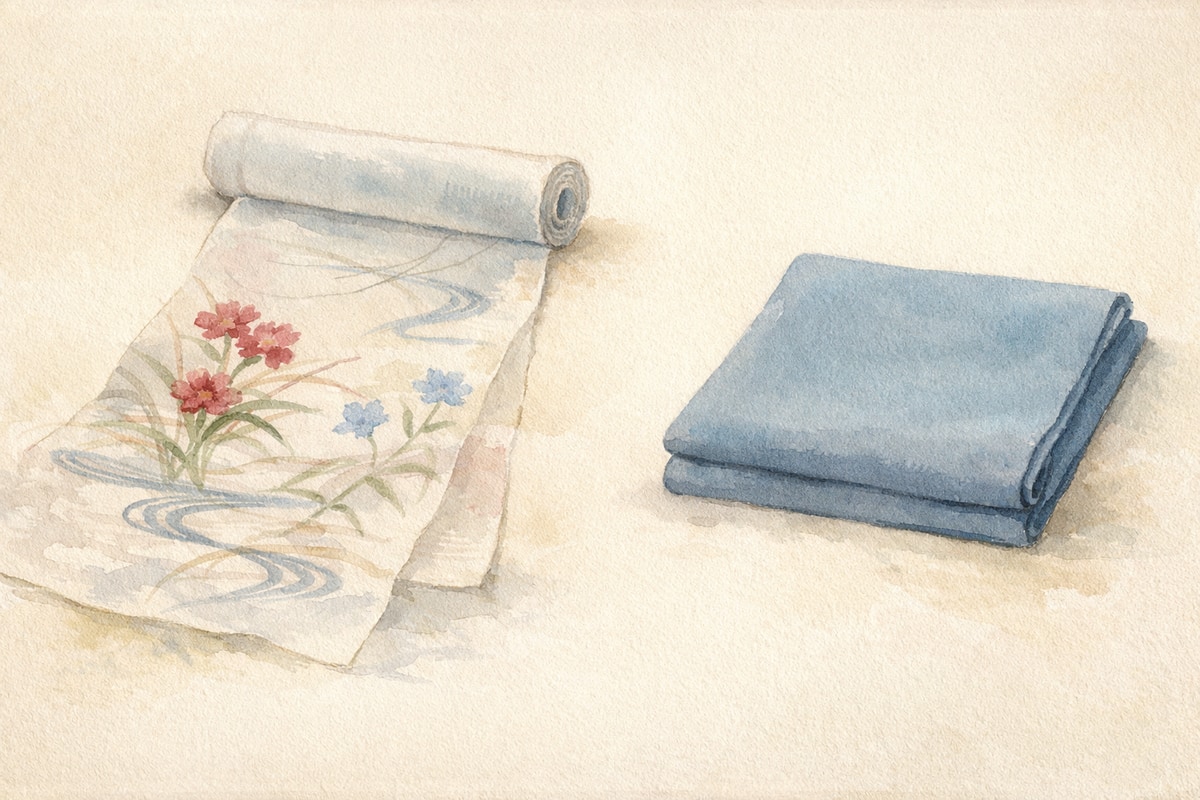
You picked a washable kimono because it looked cool and breathable, put it on, and then noticed in the mirror, “wait, my nagajuban (an under-kimono) is showing right through” — does that sound familiar? The sheerness actually comes down to how the fabric is woven, so knowing a few basics ahead of time can put your mind at ease. Today, let’s work through it step by step: why kimono fabric turns sheer, and what to look for when choosing one.
The real reason behind sheerness lies in how the fabric is woven
Two fabrics often mentioned for summer kimono are ro (a sheer, gauzy summer silk) and sha (a light open-weave sheer silk). Both have a see-through quality, but they’re woven differently. Sha is woven by twisting two warp threads around each single weft thread, creating even, uniform gaps throughout the fabric, which gives it a fairly strong sheerness. Ro, on the other hand, combines the sha weaving technique with plain weave, twisting the warp threads around every other (odd-numbered) weft thread. Because the gaps appear at regular intervals, ro ends up slightly less sheer than sha. There’s also a difference in when each is worn: ro is generally worn from June through the end of August, while sha is reserved for the height of summer, in July and August only.
Another summer kimono fabric you’ll come across is yoryu. Its defining feature is the fine vertical crepe texture — small ridges and dips on the surface — that appears as the twist in the weft threads tries to spring back. Woven from cotton or cotton-linen blends, it has a smooth, breezy feel against the skin. It also dries quickly, absorbs sweat well, and resists wrinkling, all of which make it great for summer. That said, thinner versions can be quite sheer, so some thought toward inner layers is needed, and it’s considered less suited to formal occasions.
Interestingly, even fabrics both labeled “ro” can feel quite different depending on the material. Ro made from pure silk (shoken) is soft but slightly textured to the touch; polyester ro is firmer and smoother; and cotton ro has no sheen, making it easy to distinguish from the others. These material differences affect both how sheer the fabric looks and how it feels to wear. If you’d like to dig deeper into the differences in sheerness among ro, sha, and asa (linen/hemp), take a look at Ro, Sha, Asa — The Shapes of Coolness Hidden in Sheer Kimono as well.
Why sheer kimono can look whitish: it’s about fabric and light
Have you ever noticed that a sheer kimono seems to look faintly whitish overall when you wear it? This happens for the same reason white fabric tends to look sheer in the first place. White fabric is prone to appearing see-through because light passes straight through the inside of the weave; conversely, fabric with a textured surface, or thread that’s been treated to reflect light, tends to look more distinctly whitish.
Applying this same principle to kimono: the lighter the base color of the fabric, the more easily light passes through it, and the more noticeable the sheerness becomes. Fabric with a crepe-like texture, such as yoryu, reflects light differently than flat fabric does, so even at the same level of sheerness, the visual effect can differ. That’s also why you might feel that “even though it’s the same ro, the impression of sheerness looks completely different depending on the color.”
Points to check when choosing a washable polyester kimono
Polyester is popular for washable kimono, but there’s one thing worth watching for when choosing one. Even when a garment is labeled “polyester,” the thread may actually contain silk, or be blended with natural fibers. Depending on the type, this can mean the garment isn’t actually hand-washable, so it’s essential to check the care label on the inside of the kimono before you buy it and before you wash it.
If the label indicates the item isn’t hand-washable, it’s safer to have it professionally cleaned rather than attempting to wash it at home. Assuming that “it’s polyester, so I can wash it myself no matter what” can end up damaging the fabric, so this is a point worth keeping in mind. If you’d like to compare the characteristics of shoken and polyester in more depth, see Pure Silk or Polyester: Which Is Better for Choosing a Kimono? A Gentle Breakdown of the Differences as well.
The basics of washing and drying
Once you’ve checked the care label and confirmed the kimono is washable, the next step is the washing itself. Follow the water temperature specified on the care label, and choose a neutral detergent meant for delicate clothing that doesn’t contain fluorescent whitening agents. Polyester kimono have the advantage of drying quickly and resisting wrinkles, so it’s best to spin dry for a short time only and finish by drying in the shade.
By the way, if the nagajuban is made of synthetic fiber, it’s generally fine to machine wash it, but wool kimono can develop a fuzzy, napped surface if machine washed, so hand-washing with neutral detergent is better suited to them. It might be a bit surprising that even among kimono labeled as “washable at home,” the ideal washing method still varies depending on the material.
In closing
The reason washable summer kimono can look sheer turns out to be hidden in how fabrics like ro, sha, and yoryu are woven. Ro and sha create their gaps differently, and the timing of when each is worn also shifts slightly. Yoryu, for its cool and comfortable feel, has its own tendency toward sheerness when the fabric is thin. How sheer or whitish a kimono looks also relates to how deep the base color is and how textured the fabric’s surface is. When choosing a polyester kimono, don’t forget to check the care label, and when washing, be mindful of water temperature and spin-drying time. Keep these two points in mind, and you’ll be able to choose your summer kimono with much more confidence.