
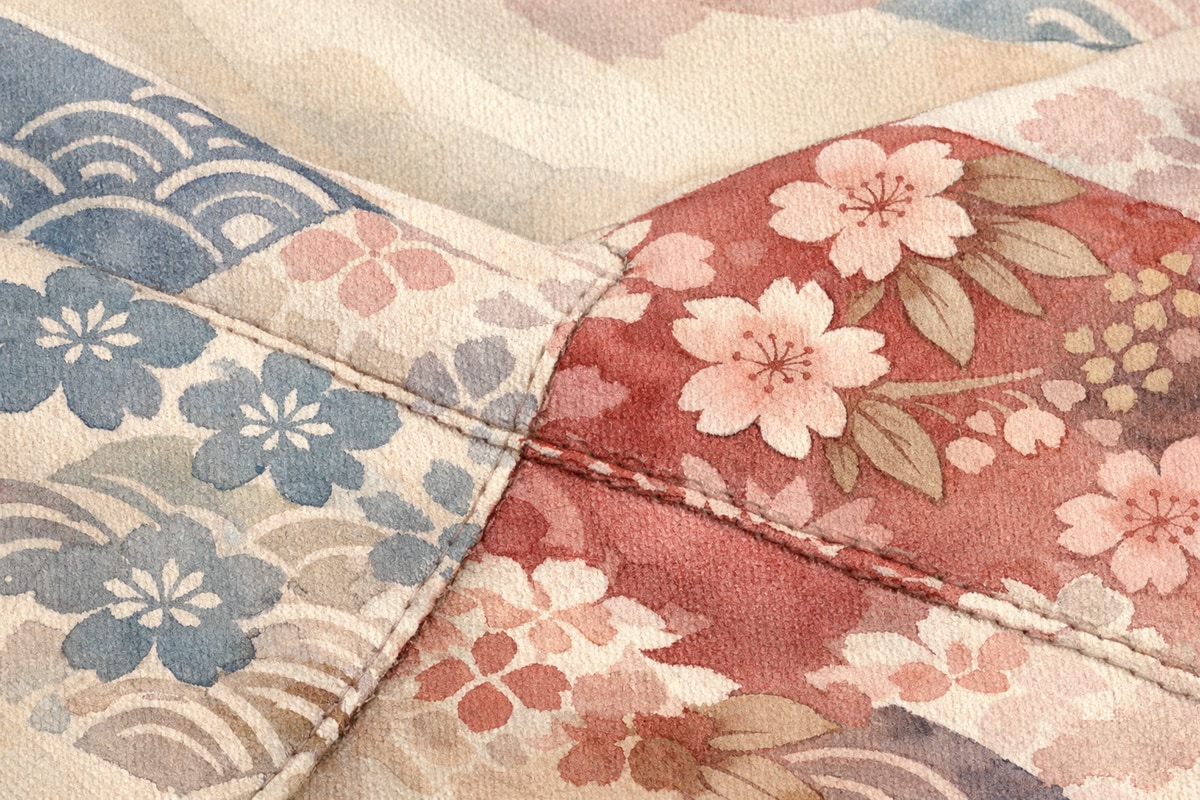
Somewhere between a Hawaiian shirt and a kimono, there is a garment that looks like neither and both. Some of these shirts are cut from an actual, decades-old kimono bolt that will never exist again in that exact pattern. Others are ordinary cotton or rayon printed with a kimono-style design, sewn by the thousand. Both are legitimate things to own, but they are not the same purchase, and a listing photo alone often can’t tell you which one you’re looking at. The difference shows up in the words the seller chooses, not just the picture.
What the fabric line in the listing is actually telling you
Every honest listing has to describe the material somewhere, and that single line does most of the work of separating the two categories. Look for the words “silk,” “vintage kimono fabric,” “repurposed,” “upcycled,” or “one bolt” used together — that combination points toward a garment cut from an actual secondhand or old-stock kimono. A listing that instead says “kimono-style print,” “kimono pattern,” or lists the fabric simply as “polyester” or “rayon” with no mention of an original garment is describing a printed reproduction, and there is nothing wrong with that as long as you know it going in. Be wary of listings that use “silk-like” or “silky” as an adjective; that phrasing usually means the fabric is not silk at all.
Remember that the seller is the one making the claim, not you and not the marketplace. If a listing says the shirt is made from genuine kimono silk, that is the seller’s description, and it’s worth checking whether the rest of the listing supports it — a vague photo and a generic description sitting next to a “100% silk kimono” claim is a mismatch worth noticing.
Reading the garment itself: seams, lining, and pattern continuity
Kimono are woven or dyed on narrow bolts, roughly 36–38 cm wide, made to be cut and reassembled along straight lines. When a shirt is genuinely built from one such bolt, the pattern often doesn’t line up perfectly at the shoulder or side seams — the maker was working with a fixed width of antique cloth, not yardage cut to order. Slightly mismatched motifs at a seam are often a sign of real reclaimed fabric, not a flaw, while a printed shirt usually shows a pattern that repeats and aligns cleanly, because it was printed on wide modern fabric specifically to be cut into a shirt pattern.
- Check whether the listing mentions the shirt is a “one-of-a-kind” or “only one available” — this is common, honest phrasing for shirts cut from a single vintage bolt, since no two panels of the original kimono are identical. See how this looks in practice.
- Look at the inside of the collar and cuffs in the photos, if shown; real kimono fabric was woven for an unlined garment folded flat, so the reverse side sometimes shows visible weave structure or a slightly duller finish compared to a printed cotton’s uniform back.
- Check whether the shirt is lined. Many kimono-fabric shirts are left unlined or only partly lined because the original silk was not woven with lining in mind; a fully lined, structured shirt is more often a printed or blended-fabric product.
What the care label tells you that the photo can’t
A care label is one of the more reliable, boring-but-useful clues, because it’s regulated text rather than marketing language. “Dry clean only” or “hand wash cold, lay flat to dry” points toward silk or a silk blend; “machine washable” is far more consistent with polyester, rayon, or cotton. Silk kimono fabric is also woven relatively fine and lightweight compared to typical printed cotton shirting, so a listing that mentions weight (often described loosely as “lightweight” or “airy”) alongside a silk claim is more coherent than one claiming silk but describing a heavy, sturdy weave.
None of these clues is proof by itself. A printed rayon shirt can carry a hand-wash label too, and a genuine silk panel can be paired with a modern lining that’s machine washable. What matters is whether the fabric description, the seam photos, and the care label all point the same direction. Cross-checking a few listings side by side makes the pattern easier to spot than reading one in isolation.
Sizing: why the tag number rarely matches what you expect
Because many of these shirts are cut from vintage Japanese kimono meant for an average build decades ago, and because Japanese ready-to-wear sizing generally runs smaller and shorter in the body and sleeve than equivalent US or European sizing, a shirt labeled “M” can fit closer to a Western “S.” Chest and shoulder measurements in centimeters or inches, if the seller provides them, are worth trusting over the letter size on the tag. This is especially true for shirts made from reclaimed fabric, since the maker was constrained by how much usable cloth the original kimono yielded, and panels were sometimes pieced to reach a workable width — occasionally at the cost of a size or two compared to a shirt cut from wide modern fabric.
If no measurements are given, look at the sleeve length in the photos relative to the model’s arm, and check whether the listing mentions a chest measurement range rather than just S/M/L. When in doubt, sizing down slightly from your usual Western size is a safer assumption than sizing to the label.
Living with the shirt once you own it
Silk from a kimono was originally cared for as an heirloom garment — folded rather than hung for long periods, kept from direct sun, and either professionally dry cleaned or hand-washed very gently depending on the piece and the owner’s own practice, since conventions here vary by family and region rather than following one fixed rule. A shirt made from that same fabric benefits from similar caution: hang it briefly for wear but store it folded for the long term, keep it out of strong sunlight to protect the dye, and avoid the washing machine even if a section of the garment (like a modern lining or buttons) seems sturdy enough for it. Printed cotton or rayon versions are generally far more forgiving and can usually be laundered according to their care label without much worry.
Either way, iron on low heat with a press cloth if the fabric is silk, since direct high heat can scorch or leave a shine on the surface — something worth testing on an inside seam allowance first, if the shirt has one.
Back to the question that started this
Real kimono silk and kimono-print cotton or rayon are both honest ways to wear this pattern language, and the choice mostly comes down to what you’re buying it for: a genuinely one-off piece of reclaimed textile history, or a wearable, low-maintenance version of the look. The listing’s own wording — the fabric line, the one-of-a-kind phrasing, the care label, and the seam details in the photos — will tell you which one is in front of you, as long as you read it as carefully as you’d read the picture. A closer look at how these details show up across real listings is the fastest way to train your eye before you buy.