You’re on the rental shop’s booking page, and both “houmongi” and “iromuji” are listed as options—and you find yourself stuck on which to choose. This is the most common dilemma when it comes to the mother’s kimono for Shichi-Go-San (a celebration for children aged 7, 5, and 3). Both are standard choices for the occasion, so you can’t really go wrong with either. The real difference comes down to just one thing: how dressed-up you want to look. Let’s start with the answer, then walk through who suits houmongi (a semi-formal kimono) and who suits iromuji (a solid-color kimono), followed by three points to check once you’ve decided.
To give you the conclusion up front: if you’re torn, houmongi is the safe choice. If you’d rather dress more modestly and let your child take center stage, choose iromuji with either one crest or no crest at all. Whichever you choose, just keep two rules in mind: don’t dress at a higher formality level than your child, and avoid colors or patterns flashier than your child’s.
Why “Don’t Outrank Your Child” Comes First
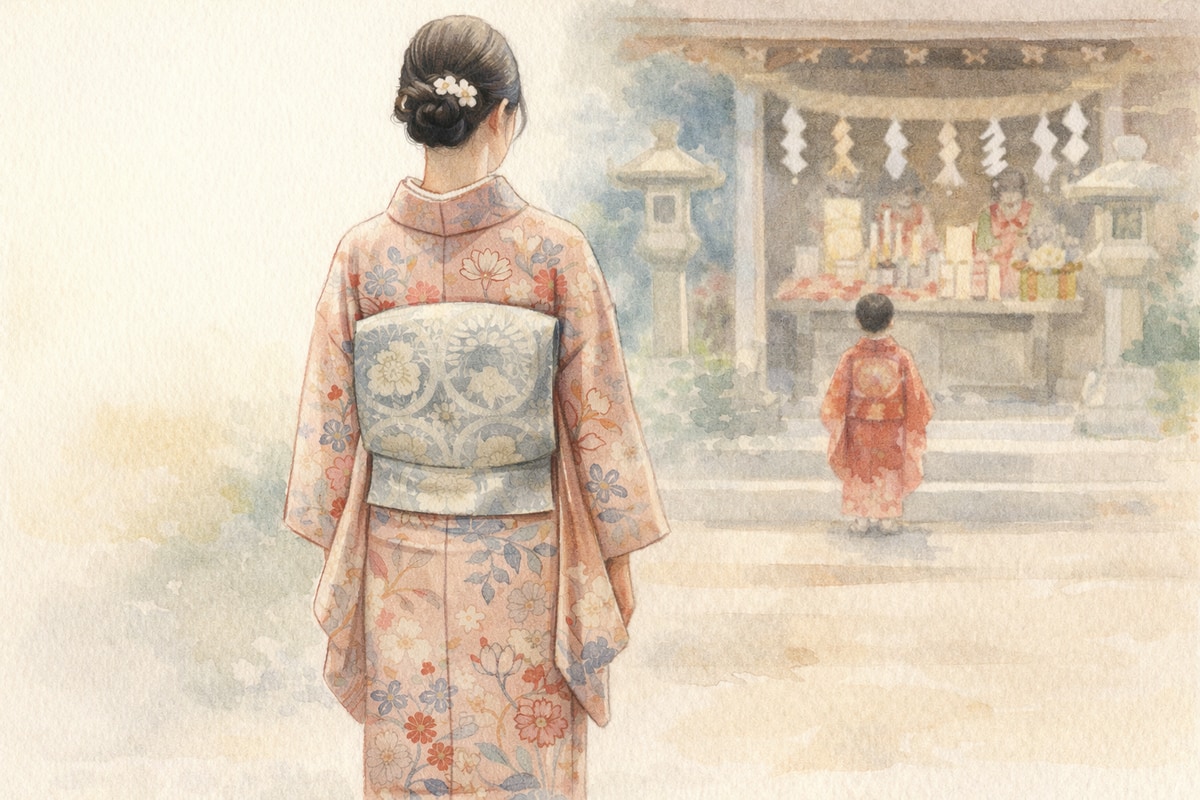
The star of Shichi-Go-San is the child. The mother’s kimono plays a supporting role, there to complement the child’s special-occasion outfit rather than outshine it. The black tomesode, the most formal kimono of all, is too high in formality and should be avoided; instead, candidates should come from semi-formal options and below, such as houmongi, tsukesage, or iromuji. Komon (a casual kimono with a small repeating pattern) or tsumugi (a textured, hand-woven silk), which lean closer to everyday wear, aren’t suited to a formal family occasion (Edo komon is an exception, which we’ll cover later).
Given this premise of “not outranking the child,” the candidates naturally narrow down to houmongi, iromuji, and tsukesage in between. From there, it’s simply a matter of how dressed-up you want to look.
Who Houmongi Suits
Houmongi is the most commonly chosen kimono for mothers at Shichi-Go-San. While many houmongi have a gorgeous look, choosing an elegant classic motif (monyou) in refined colors rather than a bold pattern with gold leaf accents will let you wear it with a calmer, more composed feel.
- Those attending their first Shichi-Go-San who don’t want to stray from the standard choice
- Those who want a touch of brightness in the family photos
- Those choosing a rental—houmongi is handled by many shops, so there’s a wide range of colors and patterns to choose from
Bright, light tones such as cream, pale pink, and pale blue are popular colors, and they read as more understated than the child’s formal outfit. As for patterns, auspicious classic motifs suit the occasion well.
Who Iromuji Suits
Iromuji is a solid-color kimono with no pattern. Adding a crest raises its formality, so for accompanying a child at Shichi-Go-San, one crest or no crest is plenty. Because it has no pattern, it plays the role of an excellent supporting player that lets the child take the spotlight.
- Those who want to dress modestly themselves and let the child stand out
- Those who prefer a calm, composed look over a showier kimono
It’s safest to stick with one crest or no crest. An iromuji with three crests rises in formality and can easily run afoul of the principle of not outranking the child. Since this is a celebratory occasion, avoid dark, somber colors. Pairing it with a formal-looking obi (the wide sash tied around a kimono) and accessories will make even a plain, patternless kimono look properly festive. For more on how the number of crests relates to formality, see our article on iromuji crests and formality levels.
Tsukesage and Edo Komon: A Middle Ground and an Exception
Tsukesage sits between houmongi and iromuji. It has a less flashy pattern than houmongi, giving a more composed look, which also makes it suitable for Shichi-Go-San. It’s an option for those who feel “houmongi is more flamboyant than I need, but plain iromuji feels too plain.”
Edo komon has “komon” in its name, but the three formal motifs known as kakudoshi, same, and gyogi carry a higher formality and are an exception suitable for Shichi-Go-San. Some shops recommend it to mothers in their late thirties and up. That said, it’s a different thing entirely from the everyday, casual-wear komon, so if you’re not sure whether a komon you already own is one of these three formal motifs, it’s safer to choose houmongi or iromuji instead.
Three Things to Check Once You’ve Decided
1. Are the colors and pattern more understated than your child’s?
Avoid dark, somber colors, bold patterns with gold-leaf accents, or overly flashy designs. Use as your guide whether the mother stands out more than the child when standing next to the child’s formal outfit. If in doubt, a pale-colored classic motif will look calm and composed.
2. Do the obi and accessories look properly formal?
A fukuro obi with gold or silver thread is the standard choice. One with a white or cream ground and a gold-and-silver-thread pattern pairs easily with either houmongi or iromuji. Coordinate the obiage (a fabric accent above the obi), obijime (a cord tied over the obi), zori (flat kimono sandals), and bag to match the formal look as well. With a rental, the necessary accessories often come as a set, so this check can usually be handled in one step.
3. Does it balance well with the father’s outfit?
Matching the formality level of both parents pulls the family’s overall look together. If the mother wears houmongi or iromuji, the father should wear a dark suit or formal suit. Avoid a mismatched pairing, such as the mother in kimono while the father wears a casual jacket. If the child is in Western-style dress, the basic rule is for the mother to match in Western dress as well.
If you’ve settled on houmongi and want the kimono, obi, and accessories delivered to your home as a full set, a home-delivery (mail-order) rental can be a convenient option. Choosing a houmongi in a classic motif and pale color will also satisfy this article’s condition of staying more understated than the child.
Choosing Western Dress Is Also an Option
If you’ll need to be on your feet looking after a younger child, or you can’t spare much time for dressing on the day, there’s also the option of the mother wearing Western-style formal dress instead. In that case, choose a formal dress or suit in a calm color such as navy, gray, or beige, matching the tone of the child’s outfit. Opt for colored formalwear rather than black formalwear, and keep in mind that a knee-length skirt is a good guideline, since you’ll likely be sitting in a chair for photos.
Summary
- When torn, choose houmongi. For a more modest look, choose iromuji with one crest or no crest
- Either way, keep to the two rules: don’t outrank the child in formality, and don’t choose colors or patterns flashier than the child’s
- Tsukesage is a middle ground; the three formal Edo komon motifs are an exception. Avoid everyday-wear komon or tsumugi
- Once decided, check three things: colors/pattern, obi and accessories, and balance with the father’s outfit
If you find yourself stuck on the booking page, start by deciding just one thing: how dressed-up you want to look. That alone will naturally point you toward houmongi or iromuji. Having said all that, the photo of you standing beside your child is sure to become a treasured memory. Once your outfit is settled, all that’s left to think about is greeting the day with a smile.
For the child’s own kimono, see our guide to kimono and preparation checklists for ages 3, 5, and 7. For whether to rent or buy the mother-and-child kimonos, see this article. For when to book, see Reservations: when should you start? For choosing a photo day, see our guide to pre-ceremony, same-day, and post-ceremony photo shoots. For cold-weather tips on the day, see this article. For the basics of kimono types and formality levels, check our quick-reference guide.