Who prepares the celebration kimono for omiyamairi, and who holds the baby — let’s get straight to the answer: there’s no longer a fixed rule that says it must be done a certain way. In the past, roles were clearly defined, but over time this has become more flexible. Here’s a look at both the traditional form and how things actually work today.
🌸 The short version (for those in a hurry)
Traditionally, the mother’s side of the family prepares the celebration kimono, and the paternal grandmother holds the baby. These days, though, both are more a matter of custom than rule. It’s perfectly fine for your family to decide together.
Who prepares the celebration kimono?
Traditionally, the celebration kimono (ubugi, a baby’s first kimono) was prepared by the mother’s side of the family. In practice today, though, it varies quite a bit.
| Who prepares it | Approximate share |
|---|---|
| The mother’s side of the family | 30–40% |
| The father’s side of the family | 30–40% |
| The parents themselves | 20–30% |
※Based on one survey’s findings as a general guide. Views vary by family and region.
Whose role is it to hold the baby?
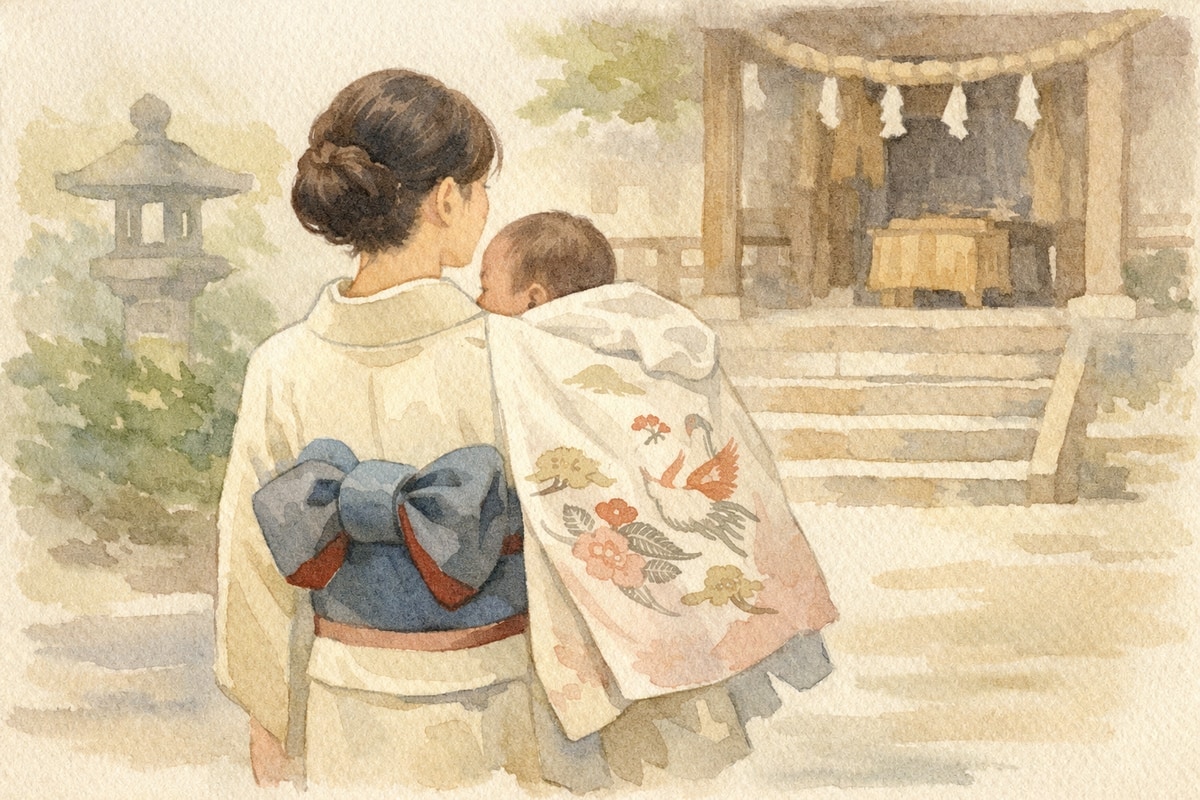
In its original traditional form, omiyamairi was carried out by three people: the baby, the father, and the paternal grandmother. This was because the mother, so soon after giving birth, was considered to be in a period of “impurity” and thought unable to join the shrine visit. As a result, holding the baby became the paternal grandmother’s role.
These days, though, most families don’t hold to this idea. It’s entirely fine for the mother to hold the baby, or for the maternal grandmother to do so. The people who take part also vary widely — sometimes it’s just the parents, and sometimes grandparents from both sides and siblings all come along together.
Keep in mind that customs vary by region
The timing and customs of omiyamairi differ from region to region. In some areas, it seems the father’s side and mother’s side even visit the shrine separately. Since “what’s normal in our area” can vary, it’s worth asking your parents or family in advance so you’re not left wondering on the day itself.
Frequently Asked Questions
Q. Both families live far away — is it okay for just the parents to do omiyamairi?
A. That’s completely fine. Many families today visit the shrine with just the parents, and there’s no need to feel bound by formal expectations.
Q. Is it better to buy the celebration kimono or rent it?
A. Both are common choices. If you don’t expect to use it many times, renting is a light, low-commitment option. For help thinking it through, this article may also be useful.
Q. Can we bring siblings along?
A. Not a problem at all. It’s quite common for siblings to join in the celebration too, and it makes for livelier commemorative photos.
In summary
- The celebration kimono may be prepared by the mother’s side, the father’s side, or the parents themselves — tradition points to the mother’s side
- Holding the baby was traditionally the paternal grandmother’s role, but today anyone can hold the baby
- Since customs vary by region, it’s reassuring to check with family beforehand
- What matters most is the spirit of celebrating together, more than the formalities
Having laid out both tradition and today’s realities, one thing remains true no matter who prepares the kimono or who holds the baby: everyone shares the same wish for the child’s healthy growth. We hope your family can approach the day in whatever way feels most comfortable for you.
If you’d also like to brush up on the basics of kimono types and formality levels, take a look at this quick-reference guide to kimono types and formality.