You’ve probably heard “book your maedori early,” but it’s easy for time to slip by without ever pinning down exactly when to act. On the actual day of the seijin-shiki (the Coming-of-Age ceremony), things get far too hectic for photos. That’s precisely why choosing the right time for your maedori (a pre-ceremony photo shoot) makes such a difference to how relaxed the big day itself feels. Let’s work through it step by step.
To get straight to the point: it’s best to avoid January to February, when the ceremony itself takes place, as well as around June, which falls in the rainy season, and instead plan around spring (March to May) or early summer (May to June). October and November overlap with the Shichi-Go-San (a celebration for children aged 7, 5, and 3) season and tend to get crowded, so if that’s the only time that works for you, it’s best to book early.
Times to avoid and times to aim for
First, let’s look at why some times are easier to book than others. January and February are when the seijin-shiki itself takes place, so studios get busy handling both this year’s shoots and reservations for furisode (a long-sleeved formal kimono) from people preparing for the following year. The rainy season, meanwhile, brings unpredictable weather, which isn’t ideal if you’re hoping to shoot outdoors.
That said, recommendations vary somewhat depending on the source. One studio’s guidance points to March through September as a good window, noting that May and July through September tend to be relatively uncrowded. Another kimono shop’s example recommends early summer, from May to June. The reasoning given is that furisode involve multiple layers, so once worn, they can feel quite warm — meaning that in the height of summer or in autumn, a person may end up perspiring partway through hair and makeup. What both sources agree on is that January to February, right before the ceremony, and October to November, when Shichi-Go-San overlaps, tend to be the busiest. Once you rule out those two windows, you can narrow things down further: children who handle heat well might manage a shoot close to midsummer, while if you’re at all concerned about the heat, aiming for early summer is the safer choice.
On-location photography as another option
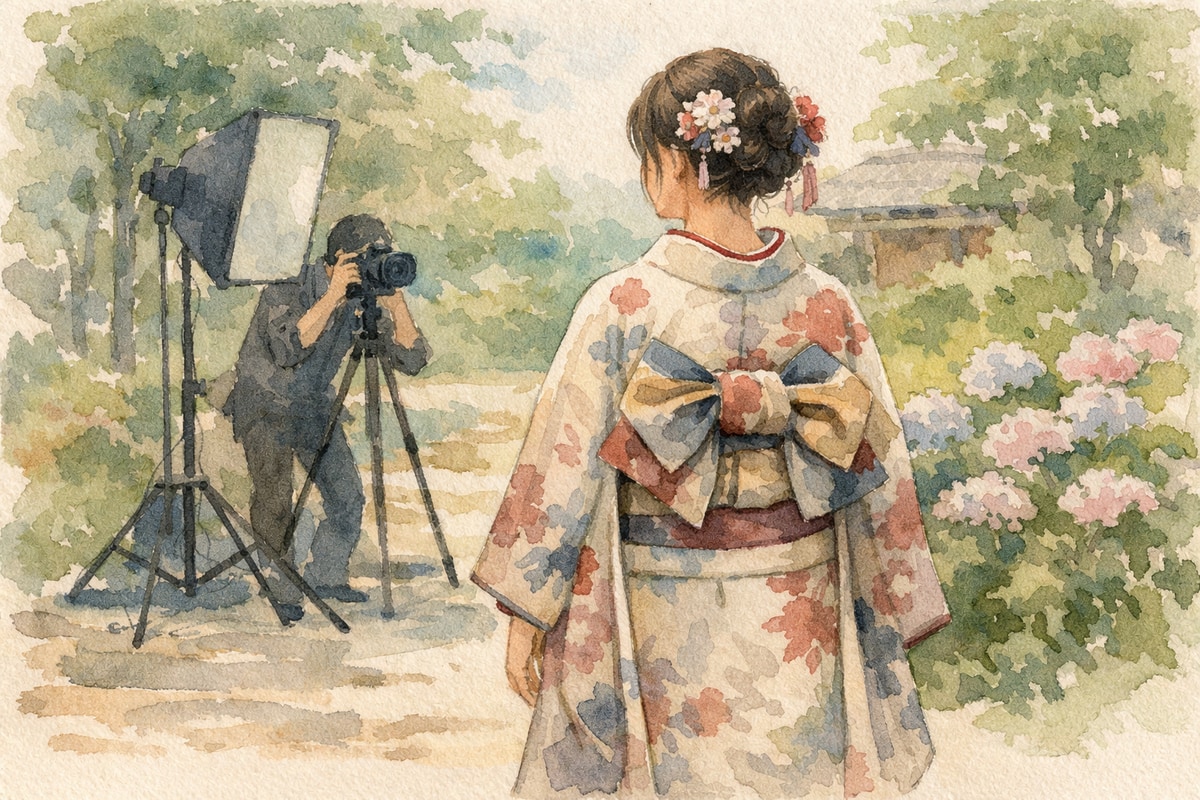
If you choose an on-location shoot rather than a studio session, prices often don’t fluctuate as much by season, so you can book without worrying too much about timing. This is worth considering if you’d like a particular location or if your schedule only allows for a busy period.
The order for choosing your furisode and timing your reservation
It’s most natural to settle on the date for your maedori only after you’ve chosen your furisode and booked your kitsuke (dressing in kimono) appointment. Following the order of choose your furisode → decide on your maedori date → book kitsuke for the day helps avoid mismatches between your outfit and your schedule. For more on timing when renting a furisode, see When Should You Book a Furisode Rental? Choosing by Season.
It’s safest to have everything booked at least six months before your desired shoot date. Some sources note that reservations start filling up around six months out, so once you’ve settled on your ideal timeframe, it pays to move quickly. Some shops offer packages that combine furisode rental with the maedori shoot, sometimes bundling in the full obi (the wide sash tied around a kimono) set, the small accessories needed for kitsuke, and even hair styling for the day. What’s included and what costs extra can vary depending on your circumstances and the shop, so it’s worth confirming the details before signing a contract.
What happens on the day, and what to bring
The typical order on the day is hair styling, followed by makeup, then kitsuke, and finally the photo shoot. As a rough guide, hair styling takes 40–50 minutes, makeup 20–30 minutes, and kitsuke 20–30 minutes — about 1.5 hours in total — plus another 30 minutes to an hour for the shoot itself. On-location shoots require additional travel time on top of that. A full studio session often takes around 3 to 4 hours altogether, though this varies depending on what’s included, so it’s wise to build some flexibility into your schedule.
If you’re using your own furisode for the shoot, checking your belongings ahead of time is essential. Gather the basic set — furisode, obi, nagajuban (an under-kimono), obiage (a fabric accent above the obi), and obijime (a cord tied over the obi) — along with accessories like zori (flat kimono sandals), tabi socks, and a shawl, plus the kitsuke tools such as a hadagi (an innermost undergarment), an obi board, and koshihimo ties. Packing all of this together the day before helps prevent anything being forgotten on the day itself. Because so many different types of items are involved, don’t put off the job of gathering and checking them all together — doing this ahead of time is the single best way to reduce stress on the day.
In closing
Once you know which times to avoid and which to aim for, and you work through the process in order — from choosing your furisode to booking kitsuke — there’s much less room for hesitation. Since the finer points of timing can vary depending on your circumstances and the shop you use, it’s always worth confirming directly with your chosen studio or kitsuke provider. Having walked through all these steps, though, what matters most is giving yourself enough time to prepare so you can greet the day with a smile. That photo of you in your formal kimono is sure to become a treasured memory.