“I’ve been invited to my mother-in-law’s third-anniversary memorial service, but how formal should my mourning wear be?” — when a memorial service invitation arrives, many people find themselves puzzling over exactly this question. Unlike a wake or funeral, the appropriate dress for memorial services gradually shifts in formality as the years pass, which can make the choice surprisingly tricky. The short answer: the safest way to choose kimono for a memorial service is to work from the three levels of mourning formality — full mourning dress, semi-formal mourning dress, and simplified mourning dress — and match them against how many years have passed since the death and your own relationship to the deceased. Let’s go through this step by step.
The Three Levels of Mourning Kimono: Full, Semi-Formal, and Simplified
First, it helps enormously to understand that mourning wear comes in three distinct levels of formality. Once you have this framework, the rest of the decision becomes much easier.
Full mourning dress
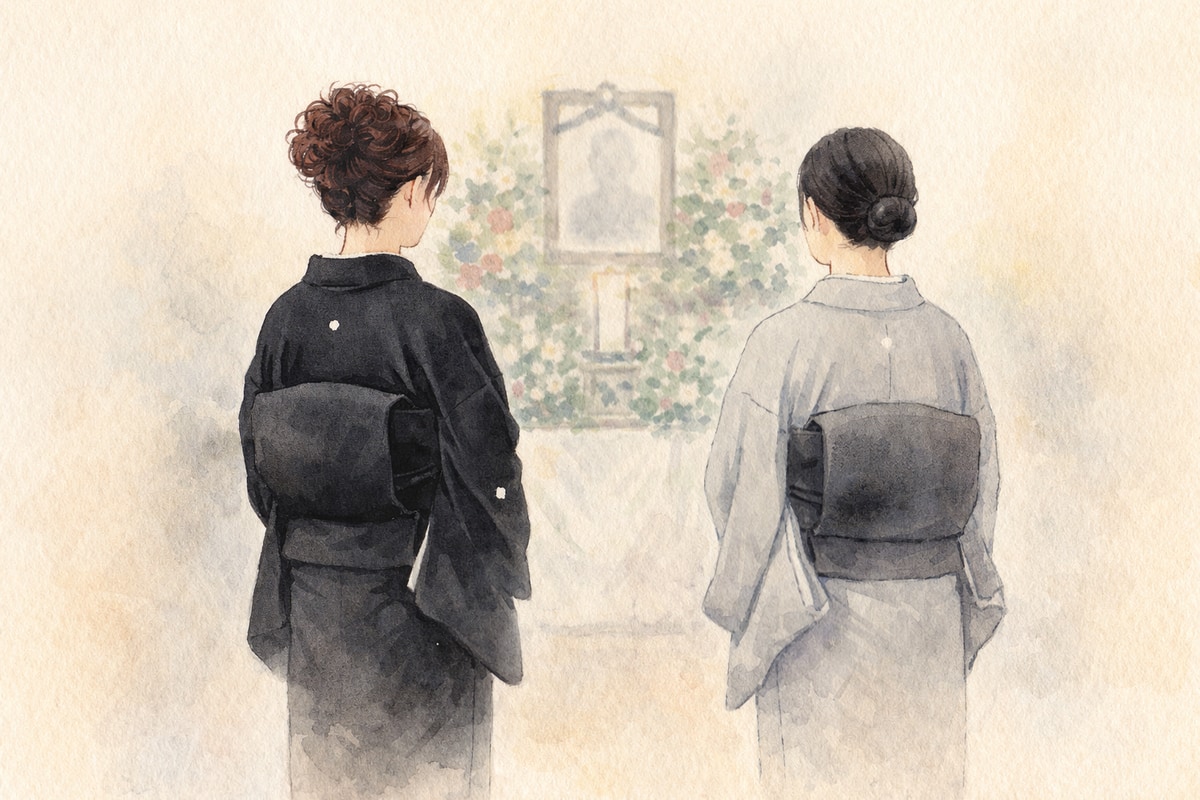
The most formal level is full mourning dress. The representative style is a solid black kimono dyed with five family crests, worn by the chief mourner (the person hosting the service) and very close relatives — typically those related to the deceased within three degrees of kinship. Since the way the crests are applied affects how formal a kimono appears, if you’d like to check which level your own mourning kimono falls into, it may help to also read about how the number of crests relates to formality.
Semi-formal mourning dress
Semi-formal mourning dress ranks just below full mourning dress, and is generally worn by guests attending the 49th-day service, the first-anniversary service, or the third-anniversary service. Among relatives too, while this varies by region and family, it’s common to wear semi-formal mourning dress up through the third-anniversary service. Even if an invitation simply says “come in regular attire,” if you’re attending as a guest it’s safest to base your outfit on semi-formal mourning dress.
Simplified mourning dress
Simplified mourning dress is less formal than semi-formal mourning dress, and corresponds to what’s generally called “regular attire.” From the seventh-anniversary service onward, this simplified mourning dress — or ordinary formal wear — becomes the standard choice. Note that an invitation saying “please come in regular attire” doesn’t mean everyday clothes are fine; it usually implies something at the level of simplified mourning dress.
How Attire Changes by Service Type: From the 49th Day to the Seventh Anniversary and Beyond
As a general rule, the formality of memorial-service attire gradually decreases with each successive service. The 49th-day and first-anniversary services call for semi-formal mourning dress, the third-anniversary service still centers on semi-formal mourning dress, and from the seventh-anniversary service onward attire shifts toward simplified mourning dress or regular formal wear. For bereaved family members, the general approach is to wear full mourning dress through the first-anniversary service, then gradually reduce the formality starting around the third-anniversary service. Confirming exactly which anniversary service you’re attending is the first step in choosing your attire. That said, the appropriate mourning wear can vary depending on the type of service, regional customs, and each family’s own approach, so if you’re ever unsure, it’s worth a quick check with relatives or the chief mourner.
Notes on Wearing Iromuji or Edo Komon as Simplified Mourning Dress
Once you reach the level of simplified mourning dress, colored mourning kimono become an option. A colored mourning kimono refers to an iromuji (solid-color kimono) bearing one or three family crests; aside from black, suitable colors are subdued, cool tones such as gray, deep purple, dark brown, dark navy, or deep green. Choosing a matte fabric such as chirimen (a crepe silk) helps create a calm, restrained impression. Given that an iromuji’s formality changes depending on whether and how many crests it bears, if you’re having one tailored specifically for memorial services, it’s worth thinking ahead about the number of crests, since this makes it easier to adjust the formality later on.
Edo komon (a finely patterned komon) can also be worn for mourning if a crest is added, but not just any pattern will do — you’ll need to choose one of the three formal patterns known as the “san-yaku”: same-komon (a shark-skin-like pattern), kaku-tsunashi (a lattice pattern), or gyogi (a diagonal-check pattern). Choosing the wrong pattern will throw off the formality of the whole outfit, so this is something to check carefully before purchasing.
Choosing the Obi, Obijime, and Accessories: Juzu Pouches and Fukusa
Formality isn’t determined by the kimono alone — the obi (the wide sash tied around a kimono) and accessories matter too. In mourning attire, the overall level of formality is understood to come from the combination of kimono and obi colors, and the basic rule is to pair a black mourning kimono with a black mourning obi. Since obi-pairing conventions can vary by region, if in doubt, sticking with a black kimono and black obi is the safest choice.
As for juzu (prayer bead) pouches, there’s no absolute rule about color. For women, subdued colors such as purple, dark navy, gray, or black are standard, while for men, calm shades of black, navy, gray, or brown tend to be chosen. For fukusa (the cloth used to wrap a monetary gift), proper etiquette for funerals and memorial services calls for a furoshiki-style wrapping cloth; a reversible type that works for both celebratory and mourning occasions, or one embroidered with a name or family crest, can serve both purposes with a single piece. The choice of juzu, juzu pouch, and fukusa often reflects one’s Buddhist sect, region, or family customs, and there’s no single answer that applies nationwide — so if you’re preparing these items for the first time, it’s reassuring to check with those around you or with relatives beforehand.
Chief Mourner or Guest? How Your Role and the Size of the Service Affect the Decision
Bringing all of this together, the final factor in choosing your attire comes down to two things: your own role, and which memorial service you’re attending. If you’re the chief mourner or a very close relative, base your choice on full mourning dress or semi-formal mourning dress; if you’re a general guest, base it on semi-formal mourning dress or simplified mourning dress. Even for the same third-anniversary service, the appropriate level of formality can differ depending on whether it’s a small family gathering or a large service with many attendees. Since this can vary by your position and by region, rather than judging solely from the wording of the invitation, it’s wise to check with the chief mourner or an older relative — that way you won’t feel out of place on the day itself.
In Summary
Choosing kimono for a memorial service becomes much easier once you use the three levels — full mourning dress, semi-formal mourning dress, and simplified mourning dress — as your foundation, and match them against how many years have passed and your own role. If you remember the general flow — semi-formal mourning dress from the 49th day through the third-anniversary service, shifting to simplified mourning dress from the seventh-anniversary service onward — you should feel more confident no matter which memorial service you’re invited to in the future. Having walked through all these details, though, what matters most about attire for a memorial service is simply that it quietly expresses your feelings of remembrance for the person who has passed. If you think of preparing your attire as one way of honoring that feeling, it may take some of the pressure off. On the day itself, please wear whatever is appropriate to your role, and attend the service with a calm and peaceful heart.