Many mothers who have had a kimono made for yuino (the formal betrothal gift exchange) find themselves wondering, “Could I wear this same kimono for the wedding ceremony too?” Having kimono made to order more than once can be costly and time-consuming, so it’s only natural to want to make do with a single garment if possible. To answer the question up front: yuino and the wedding ceremony are, by tradition, treated as occasions of different formality. That said, under the right conditions, the same kimono can indeed serve for both. Let’s go through this step by step.
The Formality of Kimono for Yuino — It Depends on Formal vs. Simplified Yuino
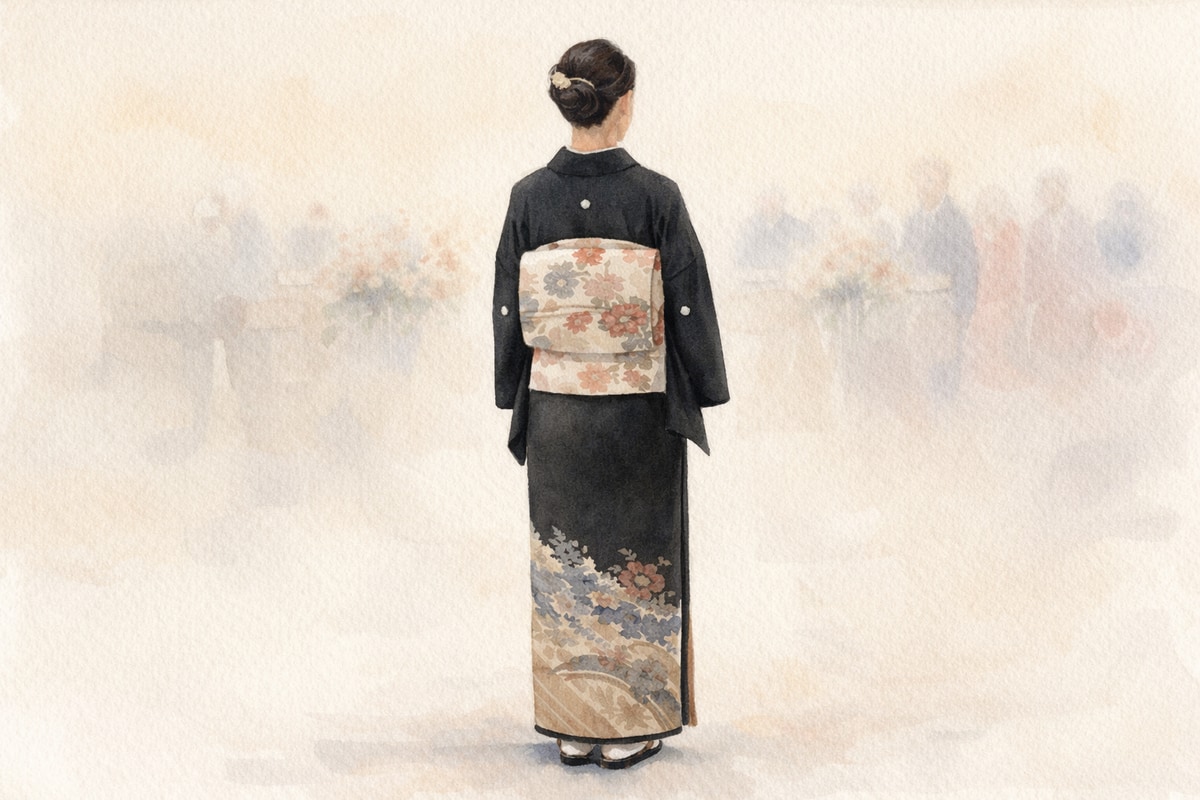
The first thing to understand when considering a kimono for yuino is that yuino comes in two forms — “formal yuino” and “simplified yuino” — and the level of formality expected of the kimono differs between them. In formal yuino, the mother wears a kurotomesode (a black formal kimono for married women) or an itsutsu-mon iro-tomesode (a colored formal kimono with five family crests), either of which counts as the highest level of formal dress for a married woman. If the daughter is wearing a furisode (a long-sleeved formal kimono), it is common for both mothers to match in kurotomesode as well.
On the other hand, in simplified yuino, or in the increasingly common casual “kao-awase” (a meeting of both families), the mother’s attire can be more relaxed. Besides tomesode, options also include houmongi (a semi-formal kimono), tsukesage (a semi-formal kimono with a more subdued pattern), or iro-muji (a solid-colored kimono) bearing a family crest — and some mothers choose not to wear wasou (traditional Japanese dress) at all, opting instead for a dress or an ensemble suit. In short, the kimono worn for yuino can vary quite a bit depending on the format chosen.
The Mother’s Kimono for the Wedding Ceremony — Kurotomesode Is the Standard
By contrast, what the mother wears on the day of the wedding ceremony itself is fairly clearly defined. It is customary for the mothers of both the bride and groom to wear itsutsu-mon (five-crested) kurotomesode, the most formal kimono available to a married woman. As the mother stands in the role of hosting the guests, wearing the most formal kimono available is a way of showing respect to those in attendance. If an iro-tomesode is chosen instead, as long as it carries five crests, it is treated as equal in formality to the kurotomesode.
That said, casual weddings have become more common in recent years, and some mothers choose something other than kurotomesode. Since this can vary by one’s position within the family and by regional custom, it’s reassuring for both families to confirm expectations with each other beforehand. For a more detailed breakdown of the mother’s attire for the wedding ceremony itself, organized by one’s role within the family, please see the related article.
Conditions for Reusing the Same Kimono
With this difference in formality in mind, the answer to whether the same kimono can serve for both yuino and the wedding ceremony becomes clear. If a kurotomesode or a five-crested iro-tomesode was worn for a formal yuino, that same kimono can be worn as-is for the wedding ceremony, since there is no mismatch in formality whatsoever.
If, however, a houmongi or iro-muji was chosen for a simplified yuino, it will not be formal enough for the wedding ceremony itself, and a kurotomesode or five-crested iro-tomesode will need to be prepared separately for that occasion. In fact, it’s said that many mothers choose exactly this combination — a houmongi for yuino and a kurotomesode for the wedding ceremony — keeping yuino relatively understated while reserving the most formal attire for the wedding day itself, a common approach.
One more thing worth keeping in mind is making sure both families’ kimono are matched in formality. If one mother wears a kurotomesode while the other wears a houmongi, the visual balance can feel off, and some have remarked that it looks unbalanced. Checking with the other family beforehand about what they plan to wear can spare everyone a last-minute scramble on the day itself.
Iro-Muji or Houmongi — Which to Choose for Yuino
When a tomesode isn’t being worn for a simplified yuino, the options that typically come up for the mother’s kimono are houmongi, iro-muji, and tsukesage. The key points of comparison are how showy the pattern is and whether a family crest is included, both of which affect formality. A houmongi is a showier kimono with an eba pattern (a continuous painted design) flowing from the shoulder down to the hem, and it can serve as semi-formal wear even without a crest. An iro-muji, meanwhile, is a solid-colored kimono whose formality can be adjusted by adding a crest, with the level of formality changing according to the number of crests used.
For mothers in their 50s and 60s attending a simplified yuino, houmongi is often said to be an easy choice, striking a pleasing balance — not too flashy, yet not too plain either. If you’re torn between houmongi and iro-muji for yuino, a related article offers a more detailed comparison, covering what to look for in order to judge which option suits the occasion and the mother’s age without feeling out of place.
| Occasion | Guideline for the Mother’s Kimono |
|---|---|
| Formal yuino | Kurotomesode or five-crested iro-tomesode |
| Simplified yuino / kao-awase | Houmongi, tsukesage, or crested iro-muji |
| Wedding ceremony | Kurotomesode (five crests) as the standard |
As the table shows, if you’d like to settle on a single kimono for both yuino and the wedding ceremony, the surest approach is to choose a kurotomesode or five-crested iro-tomesode from the yuino stage onward. For those who would like to understand the differences in formality among kurotomesode, iro-tomesode, and houmongi in more detail, please also see the related article.
In Summary
The answer to whether a mother’s kimono can be the same for yuino and the wedding ceremony depends on which format of yuino is chosen. If a kurotomesode was worn for a formal yuino, there’s no issue wearing that same kimono for the wedding ceremony as well. If a houmongi or iro-muji was chosen for a simplified yuino, please prepare a kurotomesode or five-crested iro-tomesode separately for the wedding ceremony itself. Since customs can differ depending on one’s role in the family and regional practice, it’s wise for both families to check in with each other ahead of time whenever in doubt. Having said all this, what matters most is making sure your child’s special day is a joyful one. Once the kimono arrangements are settled, all that’s left is to prepare your heart and mind so you can spend the day itself with a smile.