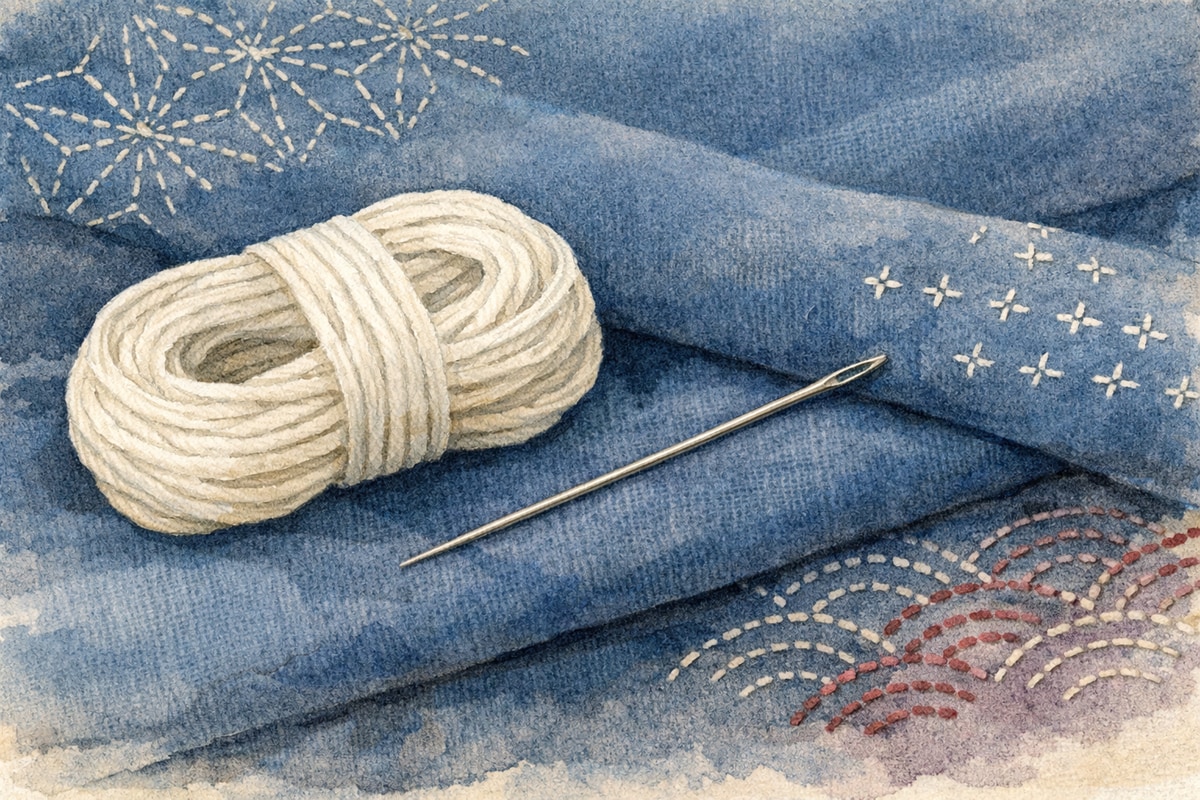
Open any sashiko search on Amazon and you’ll find kits, hoops, pre-printed panels, thimbles shaped like rings, thread in forty colors, and needle sets with names like “traditional Japanese embroidery.” It looks like a hobby that needs a shopping cart full of gear. It doesn’t. Sashiko was developed by people mending and reinforcing work clothes with almost nothing on hand, and the craft still only asks for two things you actually cannot substitute: the right needle and the right thread. Everything else is a convenience, not a requirement.
Why the needle sold as “sashiko needle” is not interchangeable with a regular one
A sashiko needle is longer and more rigid than an ordinary sewing needle, and that stiffness is the entire point. Sashiko stitching works by loading several stitches onto the needle before pulling it through the cloth, a running-stitch rhythm that gives the finished line its even, slightly raised texture. A thin, flexible embroidery needle will bow and buckle when you try to hold five or six stitches on it at once, so the length is a functional feature, not a stylistic one.
On a listing, look for the word “sashiko needle” specifically, and check the described length in the title or bullet points. You’ll usually see a range offered together: a shorter needle for finer cotton and a longer one for thicker fabric like denim or quilted layers. If a set only says “embroidery needles” or “Japanese needle set” without the word sashiko, it may be built for surface embroidery, where the needle only carries thread, not stitched fabric.
Thickness matters too, though listings are inconsistent about how they describe it. Some use a Japanese sizing system with numbers, others just say “fine,” “medium,” or “thick.” As a rule of thumb, thinner needles suit thinner fabric and finer thread; if you’re not sure which weight you’ll be using, a mixed pack with two or three thicknesses is the safer first purchase, since needle size is the one thing you can’t fix after the fact by adjusting your stitching.
Why sashiko thread is not just “thick cotton thread”
The second non-negotiable is thread, and here the confusion online is bigger, because plenty of general craft thread gets called “thick cotton” without being sashiko thread at all. Genuine sashiko thread is typically a loosely twisted, untwisted-looking cotton strand, made to lie flat and slightly matte against the fabric rather than shine like embroidery floss. That low twist is what gives sashiko its characteristic soft, chalky white line, most visible in the indigo-and-white designs the craft is best known for, though the technique itself was never limited to that color combination.
When comparing listings, the label to look for is “sashiko thread” rather than “embroidery thread” or “crochet thread,” which are twisted tighter and will behave differently under the hand, tending to twist on themselves as you pull long stitches through. Some sellers offer it as a single strand wound on a card, others as a skein you cut to length yourself; either is workable, and which one suits you is mostly a matter of preference, not correctness.
Color is where buyers most often overthink the decision. White or off-white on indigo cloth is the combination most associated with sashiko historically, particularly in the boro tradition of mending and reinforcing garments, but sashiko has also long been done in indigo thread on lighter cloth, and in regional and contemporary work you’ll find red, green, and multicolor thread used freely. There is no single correct color; the classic white-on-indigo look is a strong starting point mainly because it makes your stitch spacing and tension easiest to see and correct while you’re learning.
What you can reasonably skip when you’re starting out
Once the needle and thread are settled, almost everything else sold alongside them is optional, and knowing that will save you from a cart that costs three times what the craft requires.
- Pre-printed cloth panels are convenient for practicing a pattern without drawing it yourself, but any closely woven cotton you have, including an old shirt or pillowcase, will take a stitch just as well.
- Wooden or plastic hoops marketed for sashiko can help hold tension on large panels, but sashiko is traditionally worked flat, in the hand, without a hoop at all, so treat this as a personal comfort choice rather than a required tool.
- Thimbles vary by regional and personal habit, some stitchers use a ring-style thimble worn low on the palm to push the needle, others use none; if a listing shows an unfamiliar-looking metal ring, that’s likely what it is, not a mistake in the photo.
- Fabric marking pens or chalk are genuinely useful once you move beyond straight lines into geometric patterns, but they’re a second purchase, not part of the essential pair.
Thread is the first of the two things this article says you actually need, and this DARUMA set is the easiest way to get it: cotton sashiko thread in card form, sold as a multi-colour set with an English manual, so you are not left guessing at Japanese-only packaging. Please check the product page for current details.
Reading a listing before you buy
With the two essentials in mind, a quick scan of any listing answers most of your questions before you click buy. Confirm the needle is explicitly labeled for sashiko and states a length or a size range rather than just “embroidery.” Confirm the thread is labeled sashiko thread and described as a single loosely-twisted strand rather than stranded floss you’d separate. Beyond that, treat kits, hoops, and printed panels as things to add later once you know how you actually like to work, not things that determine whether your first stitches will succeed.
So the honest answer to what you need to buy for sashiko is short: one needle built for the job, and one thread built for the job. Buy those two correctly, and a shirt off your own shelf will do for the rest.