
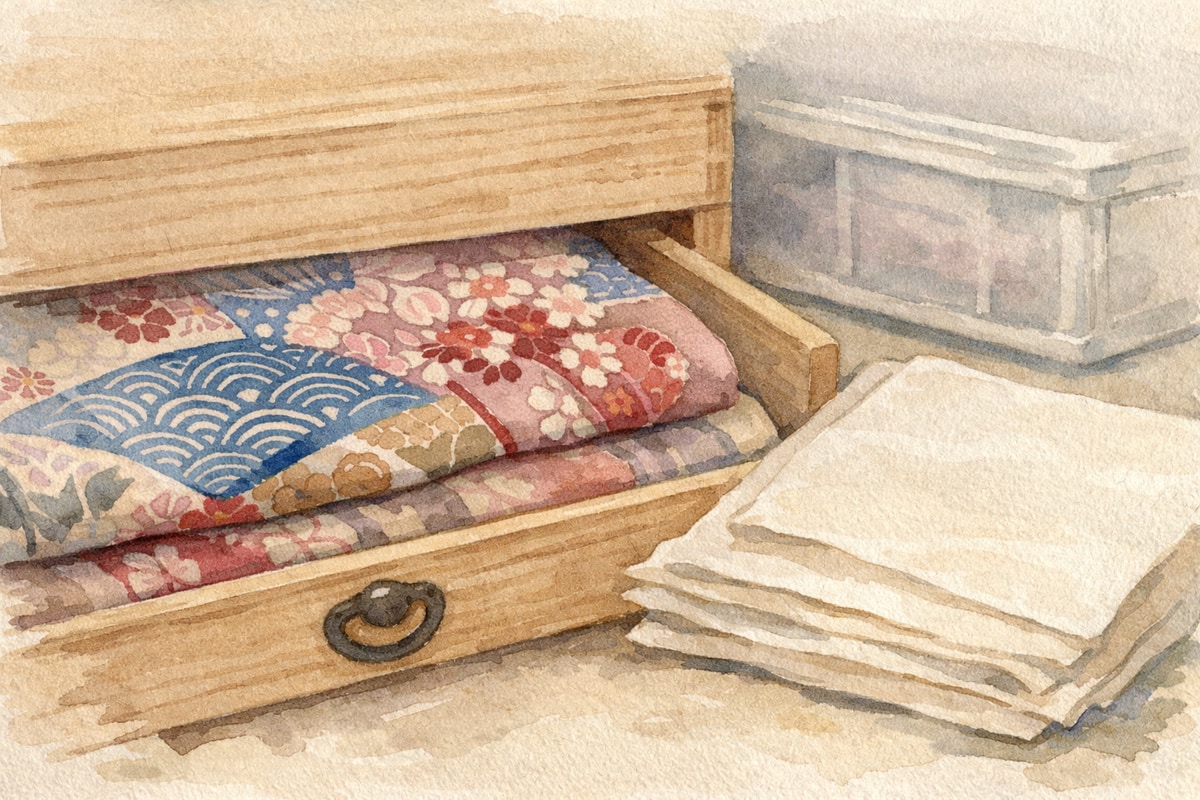
Kimono inherited from parents or grandparents that end up sitting untouched in a plastic storage case—it happens more often than you’d think. You find yourself going back and forth: “Maybe I should get a paulownia chest,” but then, “That probably takes up space and money I don’t have.” This article is written for anyone torn between storing their kimono in a paulownia chest versus a plastic storage case, and it gently sorts out the differences in how each handles humidity. The short answer: neither one is the single correct choice. The real key is understanding how each works, then choosing based on how many kimono you own and how you actually live—that’s the approach we recommend here.
How a paulownia chest regulates humidity
Paulownia chests suit kimono storage because the wood itself has a natural humidity-regulating action—it absorbs moisture from the air and releases it again. When the air is damp, it draws in moisture; when the air is dry, it releases moisture back out. It’s almost like the wood is breathing.
More specifically, when outside humidity rises, the wood itself absorbs moisture and swells, so the drawers seal shut tightly and keep damp air from seeping in. When the air dries out, the wood shrinks again, letting any trapped stuffy air escape. In fact, humidity measurements have shown that even as room humidity rises and falls, the inside of a paulownia storage case stays at a nearly constant level. Paulownia wood also contains compounds such as tannins, which are said to have antibacterial and insect-repelling properties as well. Think of the wood itself as a small built-in humidity regulator, quietly protecting the kimono inside.
The benefits of plastic storage cases—and what to watch for
Plastic storage cases have real advantages of their own. They’re affordable, you can add more as needed, and they stack neatly, making them an easy, low-commitment way to start storing kimono. Even without a paulownia chest, long-term storage is entirely possible as long as you’re mindful about dehumidifying, pest-proofing, and ventilation—so there’s no need to think you can’t store kimono properly just because you don’t have one.
That said, here’s the point worth remembering: unlike paulownia, plastic has no ability to regulate humidity on its own, and it doesn’t breathe well either. If you leave kimono inside without taking any precautions, moisture will gradually build up inside the case, raising the risk of mold and insect damage. That’s why a little extra effort helps—things like placing a slatted base underneath to let air circulate, or adding a dehumidifying sheet inside. If a paulownia chest is the type that “protects the kimono through the material itself,” a plastic case is the type where “you have to create the right environment yourself.”
Thinking about placement and lifestyle: what suits whom
A paulownia chest is a substantial piece of furniture that needs dedicated space, and it’s a bigger commitment to bring into your home than a plastic case. If you own dozens of kimono and want to care for and pass them down for years to come, the humidity-regulating power of a paulownia chest will be a reassuring ally.
On the other hand, if you only own a few kimono and want to share storage space with other items, or want something easy to move whenever you rearrange your room, a plastic storage case will likely fit your life better. Thinking it through based on how many kimono you have and how much effort you’re willing to put in makes the choice much easier.
The humidity care you can’t skip, whichever you choose
Here’s the important part: whether you choose a paulownia chest or a plastic storage case, there are shared steps for humidity and insect protection that you’ll want to take either way. Don’t let the choice of storage furniture alone put you at ease—getting these basics right narrows the gap between the two considerably.
Choose washi tatoushi, not Western paper
Kimono should never go straight into a case—they should always be wrapped first in tatoushi (a paper wrapper for storing kimono), a paper wrapping used to enclose each kimono individually. The tatoushi itself absorbs excess moisture and protects the kimono from dust and outside air. Even when storing kimono in a paulownia chest, using tatoushi alongside it is said to boost the humidity-regulating effect even further.
Here’s something worth sharing as our own editorial perspective at Koromogoyomi: choose tatoushi made of washi (Japanese paper). Washi is made by interlacing long fibers such as paper mulberry, which leaves small gaps between the fibers—this makes it breathable and lets absorbed moisture escape easily. Western-style paper tatoushi, by contrast, is made from pulp cut into short fibers and bound with chemicals, leaving far fewer gaps; it doesn’t breathe well and wears out faster. At Koromogoyomi, we see Western paper tatoushi as prone to trapping absorbed moisture inside, which can lead to yellowing and staining.
It also helps to know how to tell whether the tatoushi you already have is washi or Western paper. Washi tatoushi has a slightly rough surface, and if you look closely you can see the texture of individual fibers. By contrast, if the surface feels smooth and no fiber texture is visible, it’s likely Western paper. Some washi is surface-treated to feel smoother, so a smooth texture alone doesn’t guarantee it’s Western paper—but if you’re unsure, this is a good first check.
One thing to be especially careful about: kimono that have just come back from cleaning or maru-arai (whole-garment cleaning). When returned from the shop, they often come wrapped in simple Western-paper tatoushi or plastic bags. This is only meant to keep off dust on the way home—it isn’t meant for long-term storage. Plastic bags don’t breathe and trap moisture inside, so once you’re home, take the kimono out of the bag, and if it’s wrapped in Western paper, switch it over to washi tatoushi before putting it away.
How to use dehumidifying agents
For plastic storage cases, it’s a good idea to include a dehumidifying agent such as silica gel. For sheet-type dehumidifiers, use about one or two sheets per case as a guideline, and replace them once their effective period (roughly six months) has passed. Not overpacking and keeping to the recommended amount is the key to using them efficiently. Whichever type you use, never place the dehumidifying agent directly on the kimono or its tatoushi—position it in a corner of the case, away from the kimono itself.
One thing to watch for is the calcium chloride type, where absorbed moisture collects as liquid inside the container. If it tips over, that liquid can soak and damage the kimono. At Koromogoyomi, we recommend silica gel or sheet-type dehumidifiers for kimono storage. If you do use the calcium chloride type, use about one unit per roughly 50 liters of storage space, keep it upright, and position it away from the kimono. For more detailed, practical steps on using tatoushi and insect repellents, see our guide “How to Store Kimono: A Practical Guide to Tatoushi, Insect Repellent, and Humidity Control.”
Use only one type of insect repellent, and keep it away from gold and silver thread
Alongside humidity, how you use insect repellent matters just as much. Mixing different types of repellent together can cause their chemical components to react, melt, and leave stains or discoloration on the kimono. The basics are: stick to a single type of repellent, and place it in an upper corner of the chest or case so it never touches the kimono or tatoushi directly. If you want to switch to a different type, air out the storage space first before adding the new one.
There’s one more thing worth knowing as our own editorial perspective at Koromogoyomi: the discoloration of gold and silver thread or gold leaf. The gold and silver used on obi and formal kimono can undergo a chemical reaction with insect-repellent compounds, causing the color to dull—shops sometimes call this effect “scorching.” For kimono or obi that include gold or silver, use only one type of kimono-specific insect repellent, in the correct amount, positioned where it won’t touch the fabric.
Resetting humidity with mushiboshi airing
No matter how good your storage choice is, moisture tends to build up inside a chest or case over time. That’s why airing out your kimono—known as mushiboshi—is essential: taking the kimono out periodically and letting air pass through them. The standard approach is to wrap each kimono individually in tatoushi and stack no more than five at a time, doing this about two to three times a year. Mold tends to thrive once humidity exceeds 60%, so choosing good timing—right after the rainy season ends, or during the dry winter months—makes a real difference. For detailed timing and steps, see our guide “When and How to Air Out Kimono: A Gentle Guide from Doyo-boshi to Kan-boshi.”
Be careful with under-bed storage
Many people choose the space under a bed for their storage cases, but this spot actually tends to trap humidity. Being close to the floor with little air movement, it isn’t especially well suited to kimono storage. If you have no choice but to use under-bed space, adding a little extra care helps—choosing a paulownia-material storage case, or laying a dehumidifying sheet on the bedding side, for instance.
Our take on how to choose
We started with the question, “Which is better, a paulownia chest or a plastic storage case?”—and by now, the answer has probably come into focus. A paulownia chest is the dedicated, serious option, where the material itself regulates humidity. A plastic storage case is the practical, accessible option, easy to start with and fully capable of protecting your kimono well if you take the right precautions. Whichever you choose, the fundamentals stay the same: washi tatoushi, dehumidifying agents, a single type of insect repellent, and regular mushiboshi airing.
Picture how many kimono you own and how much care you’re realistically able to put in, and choose whichever fits your life. Once you’ve settled on your storage furniture, it’s worth getting your tatoushi and insect-repellent habits in order too—that way, you can store your kimono with real peace of mind.